



Here’s the Story the Numbers Tell and the One the Brochure Won’t!
A forensic walk-through of the Rentomojo IPO DRHP of India’s furniture-and-appliance rental leader, built from a full three-statement model and a 26-axis analysis. Educational content, not investment advice.
Both the model and the research report are free to download at the end.
Download the Free Rentomojo IPO Financial Model and Research Report
Introduction
Somewhere in Bengaluru, Mumbai or Delhi, a young professional is paying a few hundred rupees a month to rent the sofa they’re sitting on, the fridge in their kitchen, and the washing machine in the corner. They don’t own any of it and that’s exactly the point. That subscriber is the engine of Rentomojo, the rental platform that has just filed its Draft Red Herring Prospectus (DRHP) with SEBI, dated 27 March 2026, in preparation for a 2026 listing.
On the surface, it’s a tidy growth story: revenue that has more than doubled in two years, fat 40%-plus EBITDA margins, and a recent half-year where net profit margins touched a remarkable 34%. Subscribe, sit back, enjoy the ride, right?
Not so fast. When you take the Rentomojo IPO DRHP apart line by line and rebuild the business as a working financial model, a more interesting and more sobering picture emerges. This article walks you through what Rentomojo actually is, where the cracks are, who really collects the Rentomojo IPO cheque and what the business might be worth.
Stay with me, the most important number in the whole Rentomojo IPO prospectus is one almost nobody talks about.
Comprehensive Summary
- What Rentomojo Does: Rentomojo buys furniture, appliances and electronics, then rents them to urban consumers on monthly subscriptions, re-renting each item across multiple cycles to maximise its useful life.
- Rentomojo IPO Size: The Rentomojo IPO size combines a fresh issue of up to ₹1,500 million (₹150 crore) with an Offer for Sale of up to 28,399,567 shares from 19 selling shareholders.
- Rentomojo IPO Valuation: A bottom-up DCF model puts the base-case Rentomojo IPO valuation at roughly ₹44 per share, with a bear case near ₹27.5 and a bull case near ₹101.5.
- Rentomojo IPO GMP: Because the issue dates and price band are yet to be announced, the Rentomojo IPO GMP (grey market premium) is NA, while we wrote this article.
- Rentomojo IPO Legal Challenge: A former co-founder has filed an NCLT petition seeking to halt the listing, a Rentomojo IPO legal challenge covered in detail later in this article.
Key Takeaways
- The growth story has a profitability problem. Revenue more than doubled in two years, but the headline 34% profit margin is mostly a one-time tax credit; the real margin is closer to 16%, and Return on Capital Employed has collapsed from 39.2% to 12.3%.
- The IPO money isn’t going toward growth. Not one rupee of the fresh-issue funds is used for fleet expansion; it’s used to repay debt and prepay leases, while early investors and the promoter simultaneously sell shares to cash out.
- The valuation rests almost entirely on the future. The ~₹44/share base-case value comes more than 100% from terminal value (post 5-year cash flows), meaning investors are paying today for profits the company hasn’t generated yet, and a live NCLT legal challenge adds further risk on top.
First, what does Rentomojo actually do?
Rentomojo buys furniture, appliances and electronics, then rents them to urban consumers on monthly subscriptions and re-rents each item across multiple cycles; refurbishing, redeploying and eventually reselling it, to squeeze maximum life out of every asset. Rental income is ~98% of revenue, so this is a pure subscription rental business, not a retailer.
That single fact, that they own the assets they rent, is the key to everything that follows. To grow, Rentomojo must first spend cash buying the very inventory it will later rent out. The fleet is the business. And a fleet is expensive to build.
Rentomojo IPO Financials: The Growth Story and the Warnings Beneath It
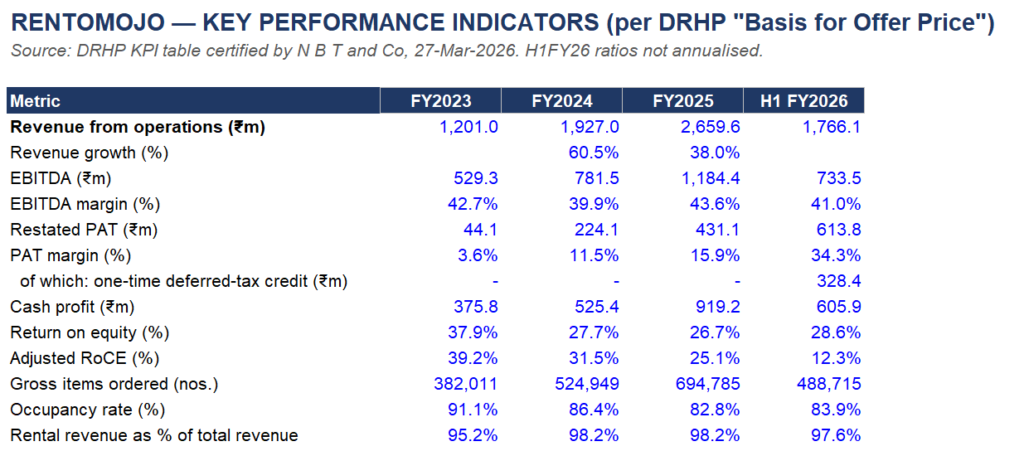
The top line is genuinely impressive; revenue grew from ₹1,201 million (FY23) to ₹2,659.6 million (FY25). But look closer and three quiet warnings appear.
1. The “profit explosion” is mostly an accounting event.
That eye-catching 34% net margin in the first half of FY26? It’s flattered by a one-time ₹328.4 million deferred-tax credit. Strip it out and normalised core profit before tax is around ₹285 million, a ~16% margin, not 34%. Anyone annualising the headline number is building on a one-off.
2. Capital efficiency is quietly collapsing.
Adjusted Return on Capital Employed has fallen from 39.2% to 31.5% to 25.1% to 12.3% across the period. The company is consuming more and more capital to earn each rupee of return, the opposite of what a scaling “asset-light tech” narrative would imply. When a business’s return on capital drifts toward its cost of capital, it stops creating economic value, however fast revenue grows. This is the most important trend in the Rentomojo IPO prospectus.
3. Growth is decelerating and the fleet is emptier.
Revenue growth has stepped down from 60.5% to 38.0%, while occupancy, the share of the fleet actually earning rent, has slipped from 91% to around 83%. A growing fleet sitting partly idle is depreciating capital, earning nothing.
The capex truth: why this business eats cash
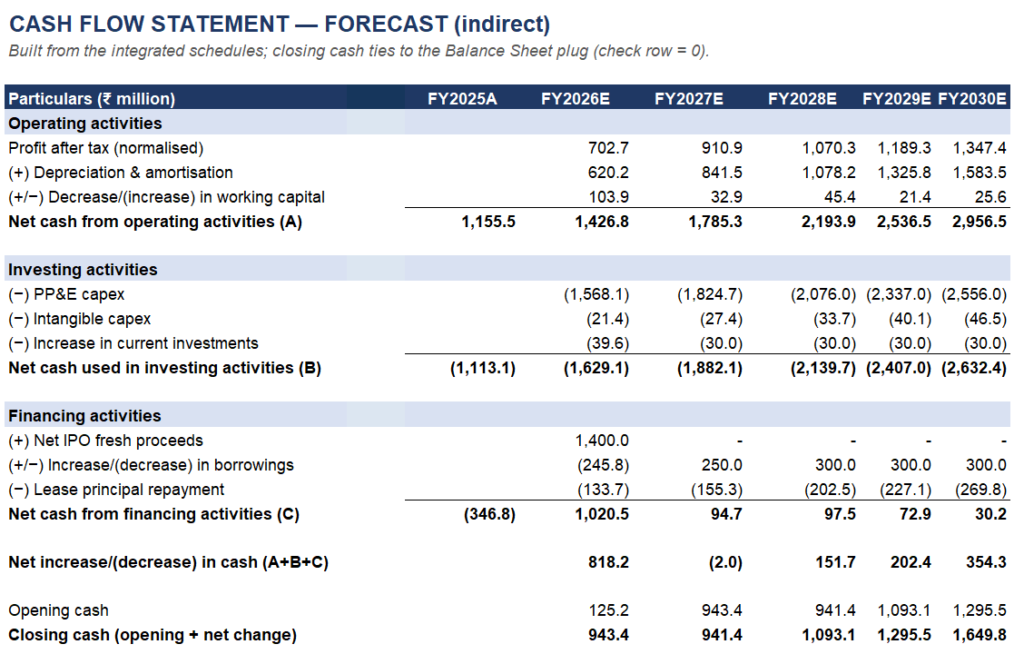
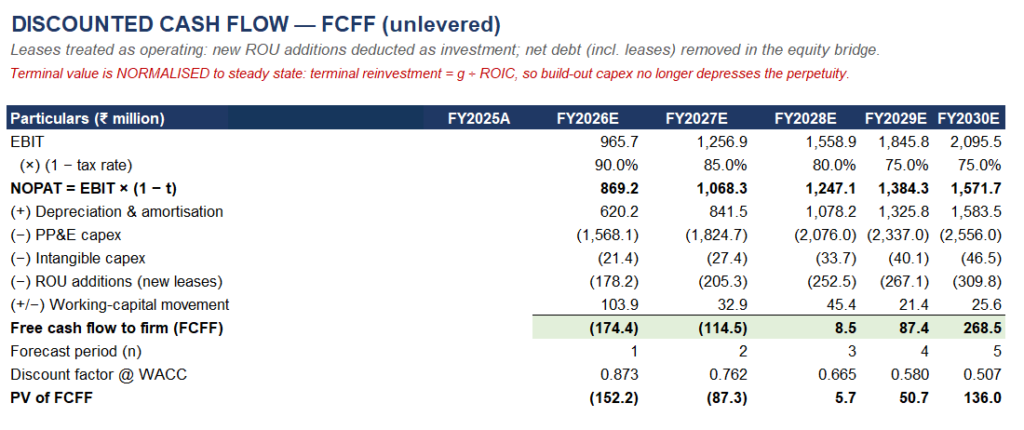
Here’s the nuance the EBITDA headline in the Rentomojo IPO hides. Depreciation isn’t an abstract non-cash entry for Rentomojo; it’s the real economic wear-and-tear on the rental fleet, the core asset. And capex runs at roughly half of revenue every year (FY25 capex was ~₹1,383 million against ~₹2,660 million of revenue).
The result: free cash flow is negative throughout a realistic five-year forecast. The cash goes out now to build the fleet; the returns arrive later. That’s not a flaw in the analysis; it’s the physics of an asset-heavy rental model still in its growth phase. EBITDA simply sits above the costs that matter most here.
So, who actually collects the Rentomojo IPO money?
This is where it gets revealing. An IPO can do two very different things: raise fresh money for the company to grow (a primary issue) or let existing shareholders cash out (an Offer for Sale). Rentomojo’s offer does both and the split in the Rentomojo IPO DRHP is telling.
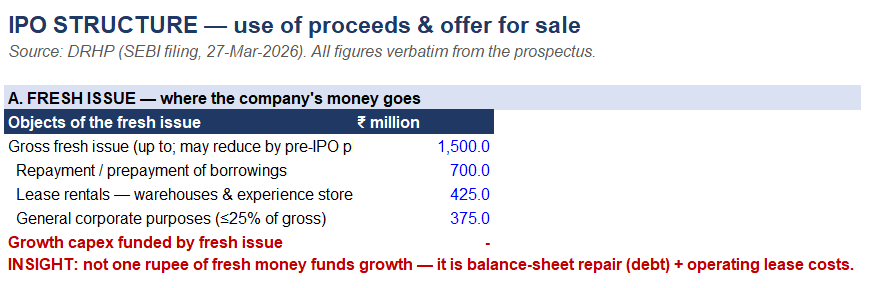
The fresh issue (up to ₹1,500 million) is earmarked as:
- ~₹700 million to repay debt
- ~₹425 million to pre-pay warehouse and store lease rentals
- The balance for general corporate purposes
Not one rupee of fresh capital from the Rentomojo IPO is allocated to growing the rental fleet, which is the entire business. This is balance sheet repair and operating cost pre-funding, not a growth raise.
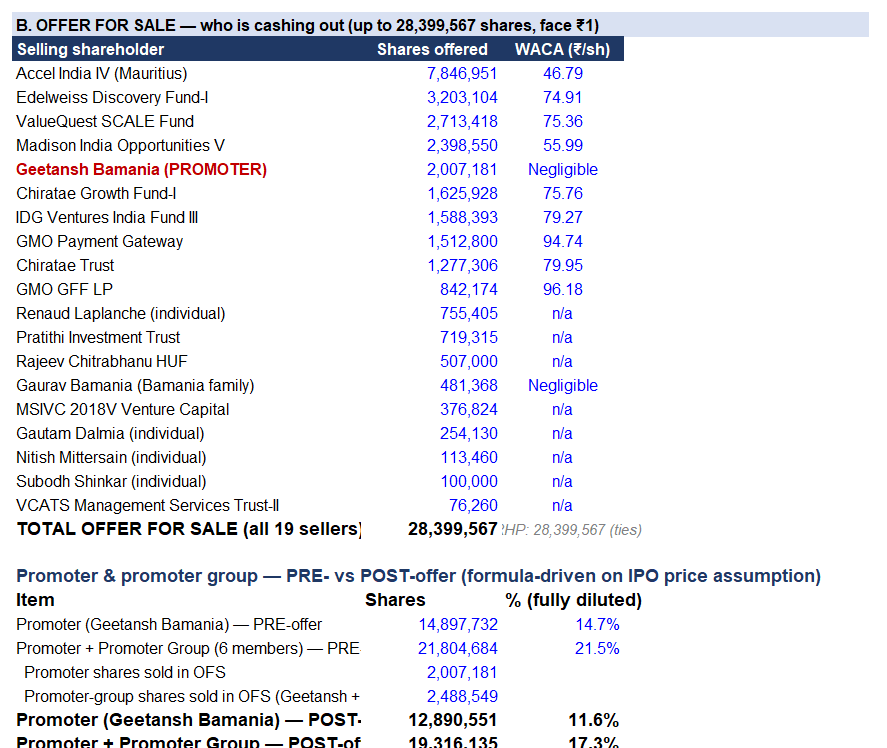
The Offer for Sale (up to 28,399,567 shares across 19 selling shareholders)
This is where the real cash changes hands, and it goes straight to early investors and insiders, not the company:
- Largest sellers: Venture and PE funds (Accel, Edelweiss, ValueQuest, Madison, Chiratae, IDG, GMO and others) who bought in at ₹47 to ₹96 a share
- Founder: Geetansh Bamania is selling 2,007,181 shares, acquired at negligible cost
- Family member: selling a further 481,368 shares
The Promoter Stakes
On promoter stake, the pre-offer holding of 21.51% is a current number, not a permanent one. Here’s what changes after listing:
- Promoter stake: ~14.7% drops to ~11.6%
- Promoter group stake: ~21.51% drops to ~17.3%
The Rentomojo IPO DRHP confirms the promoter will hold less than 20% post-offer.
What is Rentomojo’s IPO valuation actually?
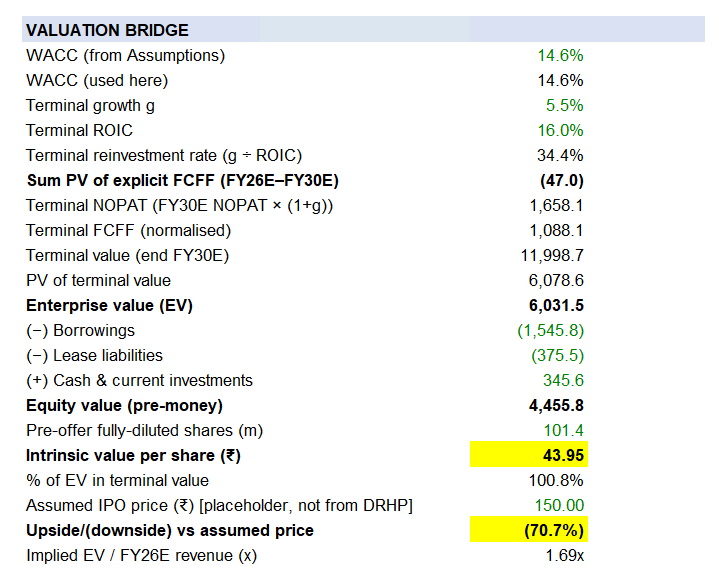
Building a discounted cash-flow valuation bottom-up from the Rentomojo IPO DRHP produces a base case intrinsic value of roughly ₹44 per share.
But the structure of that value is the real story. More than 100% of its worth sits in the terminal value, the period beyond the explicit five-year forecast.
Why? Because the forecast years are cash negative (all that fleet capex), the entire investment case rests on a steady state that lies beyond the visible horizon. In simple terms, a buyer today is paying for cash flows the company does not yet generate.
Rentomojo IPO Scenarios: Bear, Base and Bull Case Valuation – Three possible futures
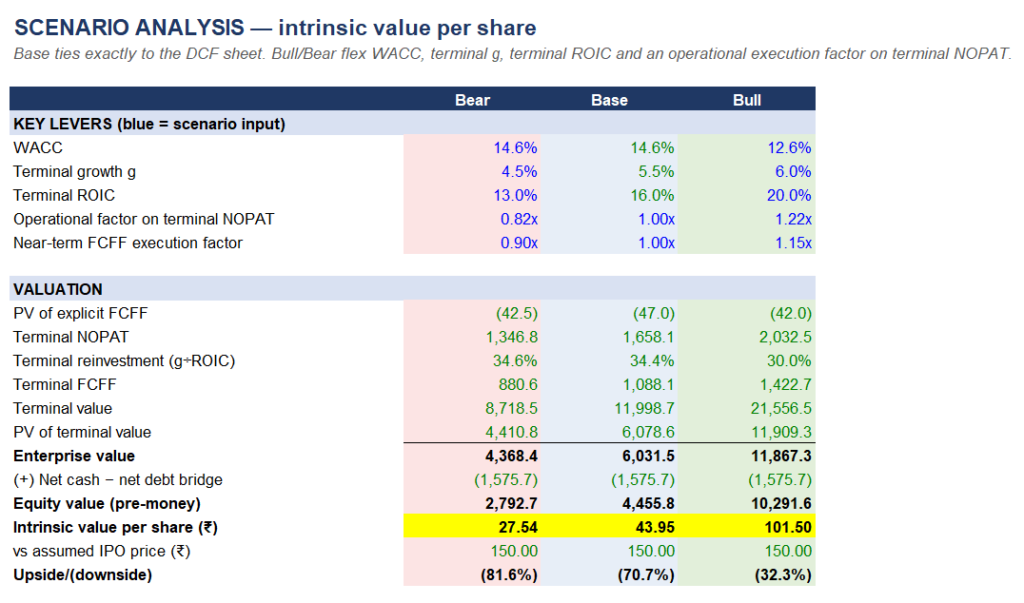
No single number captures an uncertain business, so the Rentomojo IPO model runs three scenarios. The spread is wide and instructive.
- Bear (~₹27.5): slower growth, weaker terminal economics.
- Base (~₹44): DRHP consistent deceleration, normalised tax.
- Bull (~₹101.5): sustained growth, occupancy recovery, higher steady state returns.
The gap between bear and bull is almost 4x, a reminder that, for a business whose value lives in the distant terminal period, small changes in long-run assumptions swing the answer enormously.
The investor’s dilemma: two lenses, two very different answers
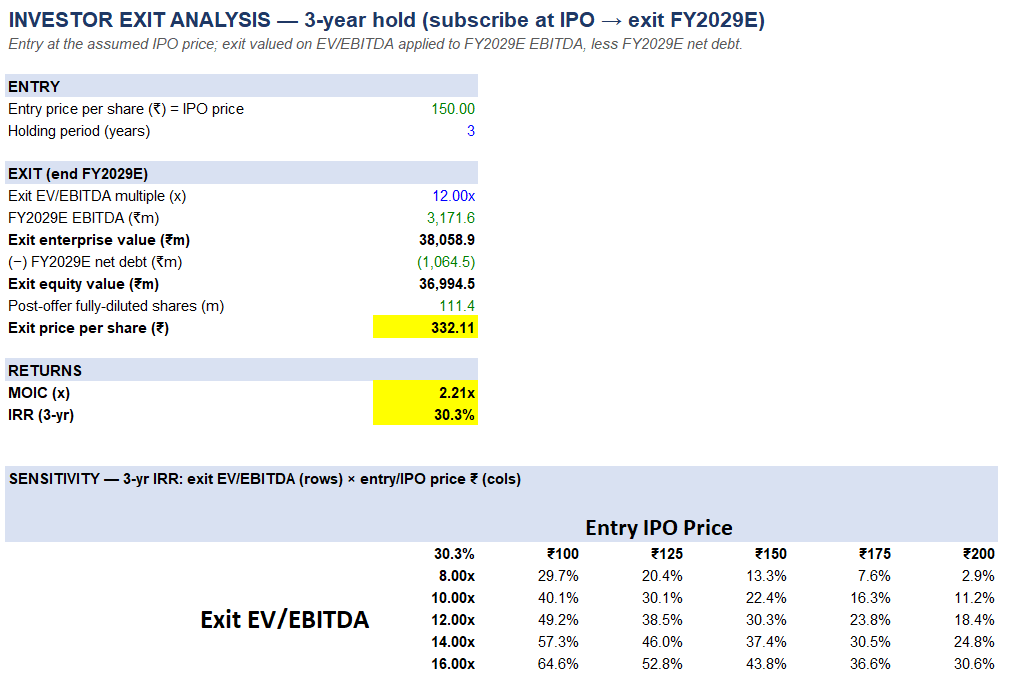
Here’s the tension at the heart of this Rentomojo IPO valuation. Value it on cash flows (the DCF, which honestly charges the business for its capex) and the equity is worth around ₹44. Value it on an exit multiple, buy at listing, sell in three years at a typical EV/EBITDA multiple, and the same forecast can show a 25–30%+ annual return.
How can both be true? Because an EV/EBITDA multiple ignores the very capex that the DCF correctly subtracts. The “upside,” in other words, is multiple dependent, not cash flow supported. It exists only if the public market keeps paying a generous EBITDA multiple for a model whose real cost lives below the EBITDA line, and keeps doing so right up to the day you sell.
The bottom line and what to watch for this Rentomojo IPO
Rentomojo is a real, resilient business in a genuinely large, underpenetrated market, run by a long-tenured founder who steered it through COVID and the funding winter. None of the above says it’s a bad company.
What it does say is that the price and structure of this offering tilt the risk-reward against the late-arriving retail buyer:
- The recent profit surge is largely a one-time tax credit.
- Returns on capital are converging toward the cost of capital.
- Free cash flow is negative through the growth phase, so virtually all value is terminal.
- The fresh money repairs the balance sheet rather than funding growth, while the people who know the business best, early investors and the promoter, are partial sellers in this Rentomojo Limited IPO.
The signposts to watch are simple: occupancy (is the fleet filling up again?), return on capital (has the slide stopped?) and the final price band in the Rentomojo IPO RHP (how much above intrinsic value are you being asked to pay?).
The most disciplined stance isn’t “yes” or “no”, it’s at what price? Anchor on intrinsic value, treat anything well above it as paying for hope and remember that the upside here rides on a market multiple, not on the cash the company is generating today.
Download the Free Rentomojo IPO Financial Model and Research Report
I have made the complete work available so you can check every number yourself:
- The Financial Model (Excel): a fully formula-driven, three-statement model with a five-year forecast, DCF and terminal-value build (with a methodology note), scenario analysis and a three-year investor exit analysis. Every historical figure is sourced verbatim from the Rentomojo IPO DRHP.
- The Equity Research Report: a 26-axis “Decoding the Company DNA” forensic assessment covering the business model, unit economics, ownership, risks, use of proceeds and valuation.
Download the Free Rentomojo IPO Financial Model and Research Report
If you found this useful, share it with someone who’s eyeing the Rentomojo IPO and tell me in the comments which number surprised you most.
Disclaimer
This article and the accompanying model and report are educational content only and do not constitute investment advice, a recommendation or an offer or solicitation to buy or sell any security. All historical figures are drawn from Rentomojo’s Draft Red Herring Prospectus dated 27 March 2026; a DRHP is a preliminary document and final offer terms (including the price band) may differ in the RHP and Prospectus. Forward-looking estimates are based on stated assumptions and are inherently uncertain; actual results may differ materially. Any illustrative Rentomojo IPO price used is a placeholder, not a DRHP figure. Securities investing carries risk, including loss of principal. Please do your own due diligence and consult a SEBI-registered investment adviser before making any investment decision. The author is not a SEBI-registered investment adviser and has no commercial relationship with the company.
Rentomojo IPO: Frequently Asked Questions
What does Rentomojo actually do, and how does its business model work?
Rentomojo, part of the Rentomojo Limited IPO, buys furniture, appliances and electronics and rents them to urban consumers on monthly subscriptions, re-renting each item across multiple cycles.
Is Rentomojo’s recent profitability real, or is it inflated by a one-time event?
The 34% net margin in H1-FY26 is mostly a one-time ₹328.4 million tax credit; normalised profit margin is closer to 16%.
What is the Rentomojo IPO issue size, and how is it structured?
The Rentomojo IPO size includes a fresh issue of up to ₹1,500 million plus an Offer for Sale of up to 28,399,567 shares, with none of the fresh proceeds going toward fleet growth.
Is RentoMojo in profit?
On paper, yes, but once the one-time tax credit is excluded, normalised profitability is much lower than the headline number suggests.
Who is selling shares in the Rentomojo IPO, and who actually receives the money?
Early investors, including Accel, Edelweiss and Chiratae, along with founder Geetansh Bamania, are selling shares through the Offer for Sale. The proceeds go to them, not the company.
What about the promoter’s stake after the Rentomojo IPO listing?
The promoter’s stake drops from ~14.7% to around 11.6%, and the promoter group’s from ~21.5% to about 17.3%, post-listing.
Why is Rentomojo’s Return on Capital Employed (RoCE) declining despite revenue growth?
RoCE has dropped from 39.2% to 12.3% as fleet capex consumes more capital than the returns it generates.
What is the intrinsic value of Rentomojo’s share based on a DCF analysis?
The base-case Rentomojo IPO valuation from the DCF model is roughly ₹44 per share.
What are the bear, base and bull case valuations for the Rentomojo IPO?
Bear case is ~₹27.5, base case is ~₹44, and bull case is ~₹101.5 per share.