



Bonus: Download our complete Excel model, research report, and investment memo below.
India’s largest stock exchange (NSE IPO) is finally coming. Here’s the part almost no one is explaining: the company itself gets nothing.
An educational deep-dive into the NSE IPO – the business, the Valuation, the GMP, NSE Unlisted Share Price, the risks, who is actually cashing out and how a regulated monopoly should really be valued. Not investment advice (full disclaimer at the end).
Download the NSE Financial Model, Research Report and the Investment Memo
Introduction
Every time someone in India buys a share, sells a future or trades an option, a tiny toll is paid. Most of the time, that toll ends up at one address, the National Stock Exchange. NSE is not a participant in India’s markets, it is the marketplace. The matching engine behind roughly nine out of ten equity trades in the country.
After nearly a decade of failed start in 2016, NSE has filed its draft prospectus (DRHP) with SEBI, setting the stage for what could be one of India’s largest-ever IPOs, the NSE IPO. The hype is enormous. The NSE unlisted share price in the “grey market” is buzzing. And yet, buried in the fine print is a fact that reframes the entire event:
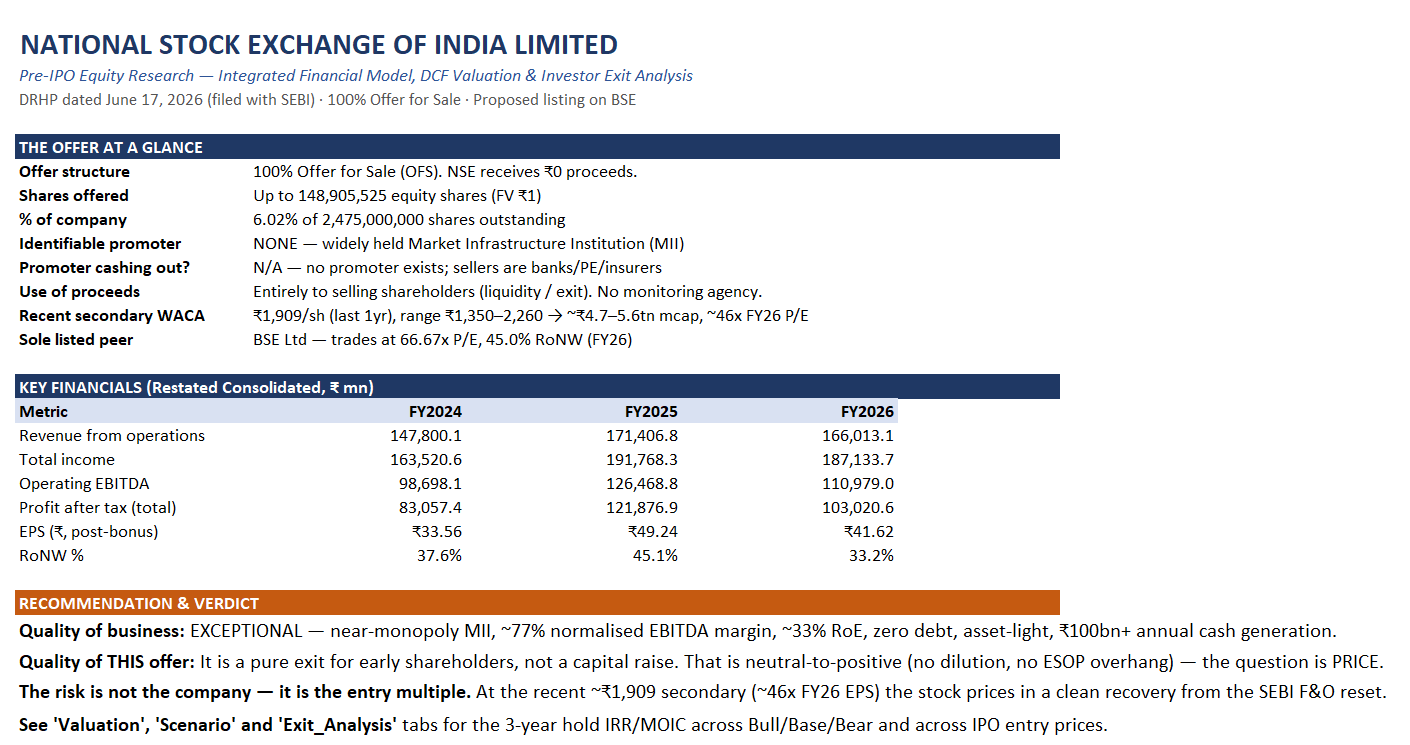
This NSE IPO is a 100% Offer for Sale. NSE, the company, will not receive a single rupee from the IPO.
So, what is this IPO really about? Let’s unpack the business, the risks, the money trail, possible NSE IPO price band and the valuation question that separates a great company from a great investment.
Comprehensive Summary
- NSE IPO Date: The DRHP was filed on 17 June 2026; the exact NSE IPO date for public bidding will be confirmed once the RHP and price band are released.
- NSE IPO Price Band: Not yet officially announced. The NSE IPO price band will be disclosed in the RHP closer to the subscription window. Our analysis and model shows a fair value price band of ₹1,258 to ₹1,867.
- NSE Unlisted Share Price: Currently trading around ₹1,950 to ₹2,055 per share in the unlisted market.
- NSE Grey Market Price: The NSE grey market price is tracking closely with unlisted market trends ahead of the IPO; the official NSE IPO GMP will firm up once the price band is out.
- NSE IPO Valuation: Implied at roughly ₹5 lakh crore based on the proposed offer size, with a fair-value range discussed later in this article.
- NSE IPO Issue Structure: This is a 100% Offer for Sale of up to ~14.89 crore shares (~6% of the company); the exchange itself raises no fresh capital.
Key Takeaways
- The NSE IPO is 100% Offer for Sale; the company gets zero rupees. Every rupee goes to early shareholders like SBI and Bank of Baroda, some of whom bought in at under ₹1 a share decades ago.
- The NSE co-location case is still open. A ₹1,491 crore settlement has been proposed, but Supreme Court appeals are pending, so the legal risk isn’t fully resolved yet.
- NSE IPO valuation needs more than a simple DCF. Blending DCF with exchange premium, peer multiples, and recent market deals gives a fair value range of roughly ₹1,258 to ₹1,867 per share.
- LIC isn’t selling. As NSE’s largest shareholder at 10.72%, LIC is holding its entire stake while other early investors cash out, a strong signal worth noting before the NSE IPO date is confirmed.
How NSE Makes Money: Business Model and Revenue Breakdown
Let’s start with what NSE actually sells – access and liquidity. It runs the order book where buyers and sellers meet and it charges a sliver on each transaction. That sliver, multiplied across billions of trades, is a remarkable machine.
The FY2026 numbers from the NSE IPO DRHP:
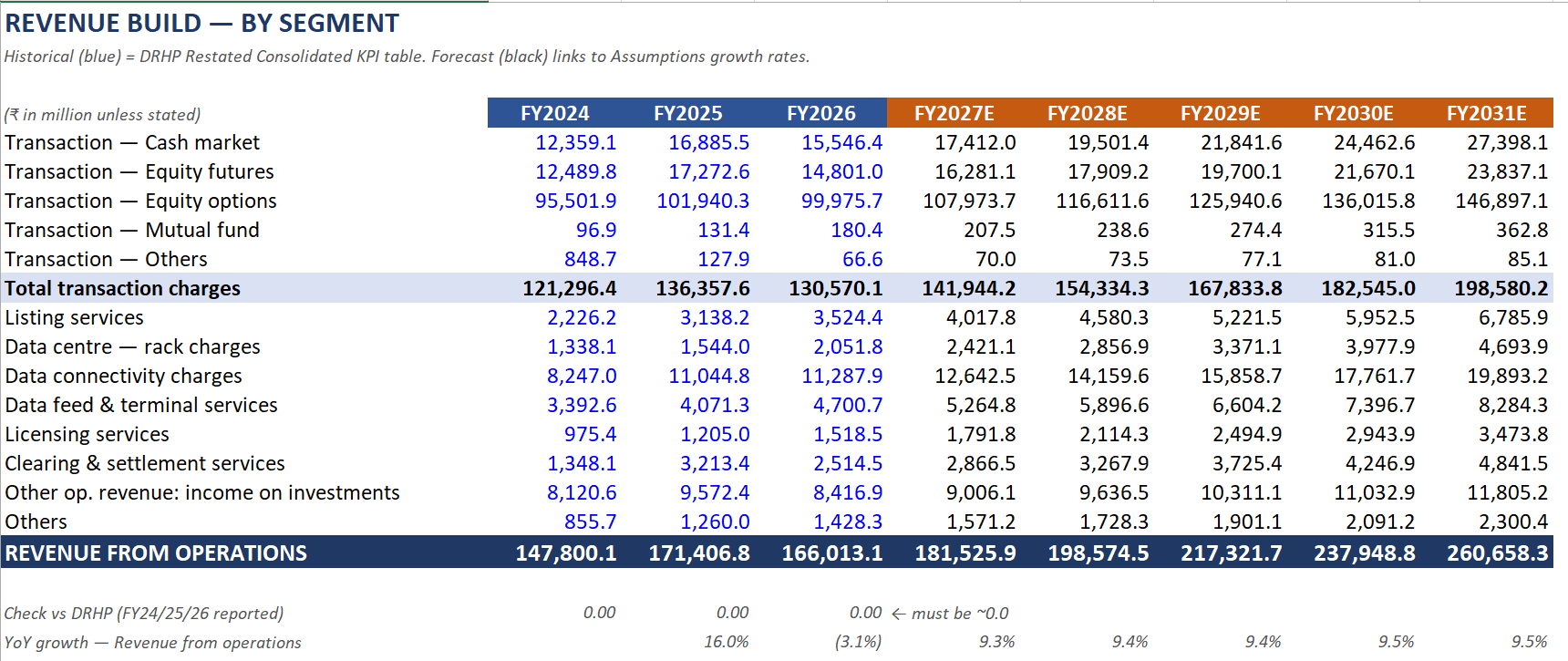
- Revenue from operations: ₹166,013 million (~₹16,600 crore)
- Profit after tax: ₹103,021 million (~₹10,300 crore)
- Normalised EBITDA margin: ~76–77% – the kind of margin software companies dream about
- Return on equity: ~33%, with zero debt and over ₹100 billion of cash generated every year
Why are the margins so absurd?
Because an exchange is asset-light. Once the technology is built, the next trade costs almost nothing to process. Incremental margins approach 100%. There is no factory, no inventory, no working-capital drag. It is, almost literally, a toll road in the cloud.
But here’s the nuance most headlines miss – concentration. Roughly 60% of NSE’s operating revenue comes from a single product, the equity options. That’s the engine. And in FY2026, that equity option engine sputtered, that is, revenue actually fell ~3% after SEBI tightened the rules on derivatives (the “F&O curbs”). So, NSE is a monopoly, yes, but a monopoly whose biggest profit pool sits directly under the regulator’s thumb.
Why Exchanges Trade at a Premium, Monopolies to NSE IPO Valuation
NSE IPO isn’t a quirk. Stock exchanges everywhere tend to be near-monopolies and investors reward them with premium valuations. There are concrete reasons for premium valuation:
- Network effects: Liquidity attracts liquidity. Traders go where other traders already are. This makes an incumbent exchange almost impossible to dislodge; that is, you cannot simply “build a competitor.”
- A regulatory moat: Exchanges are licensed, supervised market infrastructure. New entrants face a wall.
- Near-100% incremental margins: Every extra trade is almost pure profit.
- Counter-cyclical revenue: When markets panic, volume rises and so do exchange fees. The business often does well precisely when everything else does badly.
The market’s verdict on this is visible in the numbers.
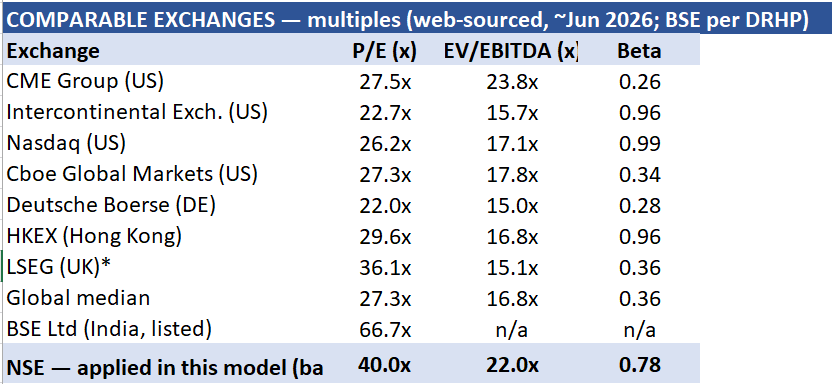
Let’s look at how global exchanges trade and crucially, at their beta (a measure of how much a stock swings versus the market):
| Exchange | P/E | EV/EBITDA | Beta |
| CME Group (US) | ~27.5x | ~23.8x | 0.26 |
| Intercontinental Exchange (US) | ~22.7x | ~15.7x | 0.96 |
| Nasdaq (US) | ~26.2x | ~17.1x | 0.99 |
| Cboe (US) | ~27.3x | ~17.8x | 0.34 |
| Deutsche Börse (Germany) | ~22.0x | ~15.0x | 0.28 |
| HKEX (Hong Kong) | ~29.6x | ~16.8x | 0.96 |
| LSEG (UK)* | ~36.1x | ~15.1x | 0.36 |
| Global median | ~27x | ~17x | ~0.36 |
| BSE (India, listed peer) | ~67x | – | – |
*LSEG’s headline P/E is distorted by goodwill amortisation; on a clean basis, it’s closer to ~22x. Multiples are illustrative, web-sourced mid-June 2026.
Notice the betas, many well below 1.0, some near 0.26. These betas tell that, the market literally treats these businesses as less risky than the average stock. They behave like bond and toll road hybrids. That single fact is the key that unlocks the NSE share price puzzle.
Why a “normal” DCF Analysis gets NSE IPO Valuation badly wrong
Here’s where most amateur valuations fall apart.
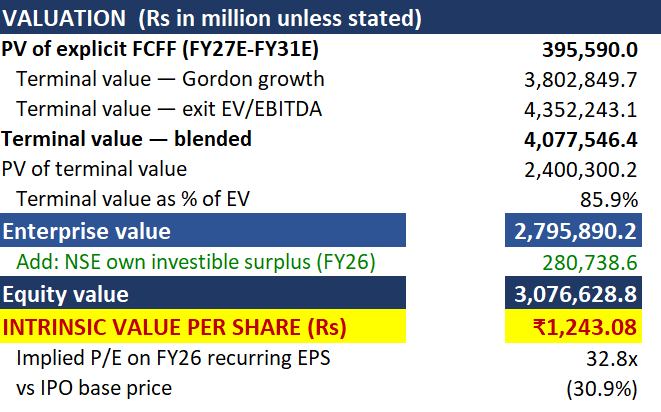
Run a textbook discounted cash flow (DCF) on NSE IPO DRHP financials, discount its future cash at a standard 12.5% to 13% cost of equity, assume modest perpetual growth and you get an intrinsic value of roughly ₹683 per share. But, that’s a fraction of what the NSE share price is in the private market.
Is the DCF “wrong”? No. It’s just answering the wrong question. A 12.5% to 13% discount rate treats NSE like an average, risky company. But we just saw that exchanges are not average, their cash flows are defensive, recurring and partly counter-cyclical, which is why their betas are so low. Therefore, the National Stock Exchange IPO price can’t be based on regular DCF.
So the DCF must be adjusted for the monopoly premium in the NSE share price:
- A lower cost of equity (~11%), reflecting the sub-1.0 beta and bond-like stability.
- A higher, longer sustainable growth rate, because a regulated monopoly compounds for decades.
- A terminal value benchmarked to how exchanges actually exit, an exchange style EV/EBITDA multiple, rather than a generic low-growth perpetuity.
Re-cast with these exchange-appropriate inputs, the DCF rises to roughly ₹1,243 per share. Same cash flows, same company, but a completely different number, simply because we stopped pretending a toll road is as risky as a startup.
And yet, even this premium DCF lands below the NSE unlisted share price and NSE grey market price. That last stretch is a scarcity premium, the value of owning a piece of irreplaceable national infrastructure that no cash flow model fully captures.
Why is one method never enough for NSE Stock Valuation?
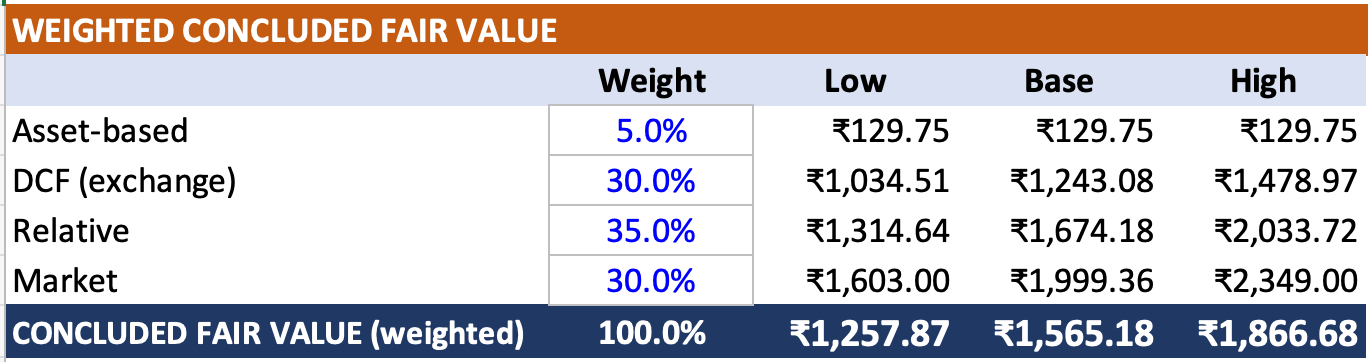
If a single DCF can swing from ₹683 to ₹1,243 depending on assumptions, you should be suspicious of any single number. Serious valuation triangulates across multiple independent methods, then weights them by how much you trust each one for this kind of business:
| Method | What it captures | Weight |
| Asset-based (NAV) | A hard floor, but ignores the monopoly value | 5% |
| DCF (exchange-adjusted) | A disciplined cash flow anchor | 30% |
| Relative multiples | What the market pays for comparable exchanges | 35% |
| Recent transactions | What real buyers actually paid for NSE shares | 30% |
Why these weights? For a regulated monopoly, market evidence (what comparable exchanges and recent buyers actually pay) is more reliable than a single modelled DCF. And asset value is only a floor (you cannot rebuild NSE’s network at “book value” at any price). So, blending them, the concluded fair value lands around ₹1,565 per share, in an NSE IPO price band of roughly ₹1,258 to ₹1,867.
The discipline of weighing forces honesty; no method gets to dominate, and the range reminds you that this is a judgment, not a fact.
So, who is making money from the NSE IPO Offer for Sale?
Back to the fact we opened with. This is a 100% Offer for Sale (OFS), meaning the shares being sold are existing shares held by existing shareholders. In this NSE IPO, no new stock will be issued; that is, the company receives nothing.
For a new investor, that’s actually neutral to positive – no dilution of your stake, no fresh debt, no “promoter” dumping stock (NSE has no identifiable promoter) and no employee stock option overhang (exchange regulations bar it). The entire question collapses to one word, the price.
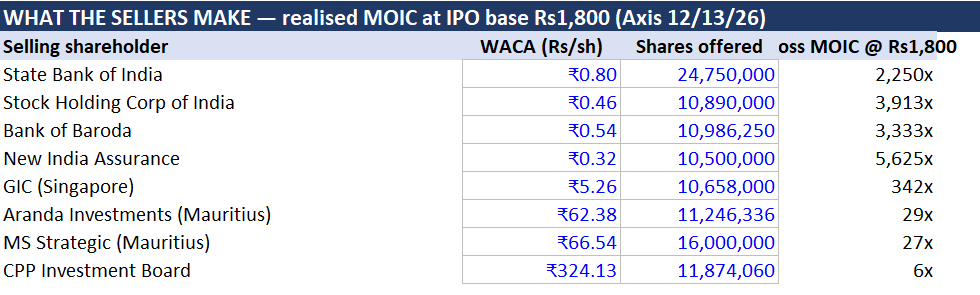
But follow the money trail, and it gets fascinating. The sellers include public sector banks, state-owned insurers and global funds, many of whom bought their stakes years ago at a near-zero cost. For some, the weighted-average cost of acquisition is under ₹1 per share. At an NSE IPO price near ₹1,800, that’s a return measured not in percentages but in multiples of thousands of times. These are among the most spectacular institutional exits India will ever see.
The LIC signal
Life Insurance Corporation of India (LIC), the single largest shareholder, with a 10.7% stake, is not selling.
Think about what that means. The most informed, most patient, largest domestic institution on the cap table is choosing to hold through the IPO rather than cash out at a euphoric NSE grey market price. There are several possible readings, a long-term strategic view, a belief that the best is yet to come or simple regulatory and optics caution. But when the biggest insider keeps its chips on the table while others rake theirs in, that asymmetry is something every reader should weigh for themselves.
What is the current status of the NSE Co-location Case?
This is not NSE’s first dance with the public markets. Back in 2016, the IPO was nearly ready. Then the co-location scandal struck, allegations that some brokers got preferential, faster access to the exchange’s servers (the infamous “dark fibre” and unfair latency advantage), alongside serious governance lapses. So, all these reasons, SEBI froze the NSE IPO process in 2016. The listing simply never happened.
Here is what has changed:
- The business is far larger and more profitable than in 2016 and more diversified across data, listing and clearing services.
- Governance has been overhauled, new leadership, new board, new controls.
- Most of the old enforcement matters have been largely won at the Securities Appellate Tribunal (SAT) and a revised settlement has been filed.
What has not changed:
- The co-location case is still not fully resolved. SEBI’s appeals remain pending before the Supreme Court. The original sin still casts a faint shadow over the listing.
- The structural dependence on equity options remains and is arguably riskier now, because SEBI has actively been throttling that very segment.
- In other words, the company that’s listing in 2026 is a much stronger, cleaner version of the one that stumbled in 2016, but it carries the same two question marks into the public markets.
What risk are buyers really underwriting in the NSE IPO price?
Strip away the glamour and these are the things that can hurt:
- Regulatory throttling of options: NSE’s biggest profit pool is the one SEBI is most actively curbing. FY2026 revenue has already declined.
- The co-location legal tail: Still pending in the Supreme Court.
- Single market, single regulator dependence: NSE’s pricing power exists only within the limits SEBI permits. The regulator is simultaneously its enabler and its ceiling.
- Growth deceleration: A monopoly that just shrank is a reminder that “dominant” doesn’t mean “always growing.”
- Valuation risk: This may be the biggest one, more on risk in covered below.
- Technology and cyber risk: A market-wide outage is an existential operational hazard.
Why will the NSE IPO price probably be below the NSE grey market price?
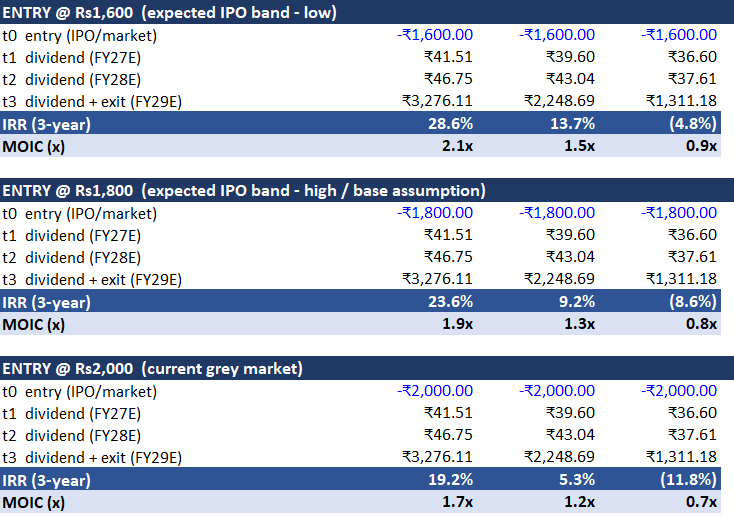
If NSE shares change hands privately around ₹2,000 to ₹2,055 today, why do analysts expect the NSE IPO to be priced lower, around ₹1,600 to ₹1,800?
Four possible and concrete reasons:
- Supply absorption: A ~₹30,000 crore offer floods the market with far more stock than the thin grey market clears. Absorbing that volume requires a price concession.
- The IPO discount convention: Bankers deliberately leave money on the table, that is, pricing below assessed value to ensure a fully subscribed book and a healthy “listing pop.”
- Dominant incumbent at a discount: NSE’s growth is currently flat-to-negative, so the market applies a lower multiple (~38 to 43x) than it gives the faster growing, smaller BSE (~67x).
- Book building reality: With LIC not selling and a huge block to place, the price must clear with large institutional buyers, who negotiate hard.
The practical upshot, a subscriber allotted near the lower end of the band, against a richer grey market, has a plausible path to listing gains, while the NSE grey market price itself already sits above the fundamental fair value. Entry discipline, not enthusiasm, is what turns a great business into a good investment.
What Is the Future Outlook for NSE Share Price: Bull, Base or Bear Case?
The tailwinds are real. India is in the early innings of a financialization supercycle
- approx129 million unique registered investors and climbing,
- rising market capitalisation, and
- structural growth in passive funds tracking NSE’s Nifty indices.
NSE sits at the centre of all of it.
The headwinds are equally real.
- Its largest pool, options, is maturing and actively regulated, and
- there is a regulatory ceiling on how much it can ever charge.
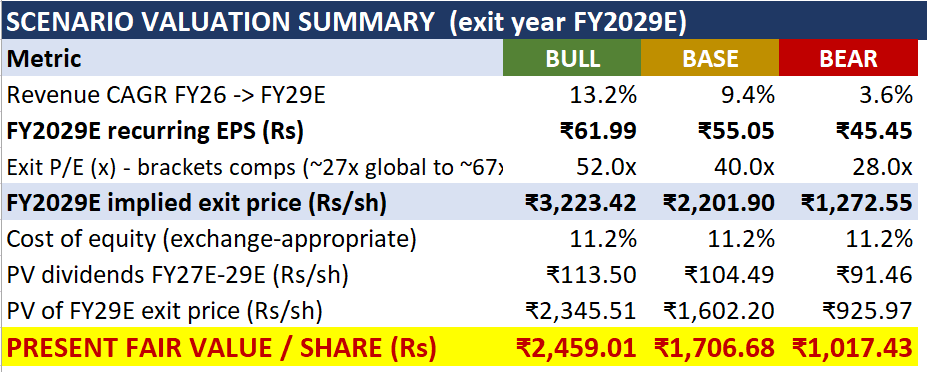
Run the three-year scenarios and the cone of outcomes is wide:
- a present fair value of roughly ₹2,459 in the bull case,
- ₹1,707 in the base case, and
- ₹1,017 in the bear case.
That asymmetry, driven almost entirely by two swing variables, the options growth rate and the exit multiple. And this is precisely why the price you pay matters more here than the quality of the business (which is not in doubt).
Will the NSE IPO price be fairly valued? Final Verdict
NSE is, by almost any measure, an exceptional business, a regulated near-monopoly, software-like margins, a fortress balance sheet and a front-row seat to India’s growth. And the structure of this NSE IPO offer is unusually honest, no dilution, no controlling shareholder cashing out (NSE has no promoter at all), no leverage, no option overhang.
But “great company” and “great investment” are not the same sentence. The grey market is already pricing in a near-flawless future, while the most informed insider (LIC) on the cap table quietly holds. A disciplined framework suggests the NSE business is worth around ₹1,565 at the centre of a wide range, which means the margin of safety thins quickly as the price climbs toward ₹2,000.
The lesson isn’t “buy” or “avoid.” It’s that the number you pay is the entire investment and working out that number, honestly and with multiple lenses, is a discipline worth far more than the next hot tip.
Download the full analysis of NSE IPO based on DRHP dated June 17, 2026.
I have made the complete working excel files available so you can audit every assumption yourself and make changes based on your understanding.
- NSE Financial Model (Excel): a fully formula driven, three-statement model, exchange premium modelling with a multi-method valuation, scenario engine and investor-exit analysis.
- NSE Equity Research Report: the full write-up behind this article. Evaluated NSE IPO on 26 proprietary business axis framework.
- NSE Investment Memo: the NSE IPO decision summary.
Download the NSE Financial Model, Research Report and the Investment Memo
Important disclaimer, please read
This article and the accompanying model, report and memo are for educational and informational purposes only. They are NOT investment advice, NOT a recommendation or NOT a solicitation to buy, sell or subscribe to any security, including the NSE IPO.
- The author is not a SEBI-registered investment adviser or research analyst and nothing here should be relied upon as personalised financial, legal or tax advice.
- The NSE IPO price band has not been announced. Any prices referenced (e.g., ₹1,600 to ₹1,800, ₹2,000) are assumptions or third-party/grey-market observations, not official figures and may be wrong.
- The valuation outputs depend on assumptions that may not hold. Small changes in growth, discount rate or exit multiple can change the conclusions materially. The fair value range is a judgment, not a fact.
- Historical figures are drawn from the publicly filed DRHP; forward estimates are the author’s own and are inherently uncertain.
- Past performance and NSE grey market prices are not indicative of future results. Markets can and do fall. You can lose money.
- Do your own research and consult a SEBI-registered investment adviser before making any investment decision. You are solely responsible for your own choices.
Frequently Asked Questions
What is the NSE IPO?
The NSE IPO refers to the National Stock Exchange of India’s proposed public listing, set up entirely as an Offer for Sale of close to 14.89 crore shares. The DRHP for this issue was filed on 17 June 2026.
What is the NSE share price today (unlisted market)?
In the unlisted market, NSE shares are currently changing hands in the range of ₹1,950 to ₹2,055 each, with the official price band still to be announced.
What are NSE unlisted shares, and how are they different from listed shares?
NSE unlisted shares are shares bought and sold privately before the company lists on a stock exchange. Unlike listed shares, they don’t trade on a public exchange, so liquidity is lower and pricing is far less transparent.
What is the NSE grey market price, and is it reliable?
The grey market price for NSE shares is currently moving in line with unlisted market levels. It gives a rough read on demand but is only indicative, and it can change quickly once the price band is officially out.
What is NSE IPO GMP, and why might it differ from the actual issue price?
NSE IPO GMP is the unofficial premium that buyers are willing to pay above the expected issue price.
When is the NSE IPO date expected?
The DRHP went in on 17 June 2026. The actual subscription dates will only be locked in once SEBI clears the issue and the RHP is filed.
What is the expected NSE IPO price band?
No official price band has been released yet. It’s expected to be announced closer to the listing, alongside the RHP. Our analysis expects a price band of ₹1,258 to ₹1,867. Please check the financial model on how we have arrived at this band for the NSE IPO.
Disclaimer: our analysis is educational content only and does not constitute investment advice, a recommendation or an offer or solicitation to buy or sell any security.
Is the NSE IPO a fresh issue or an Offer for Sale? Who gets the money?
The NSE IPO is entirely an Offer for Sale; the company raises no fresh capital, and all proceeds go to existing shareholders such as SBI, Bank of Baroda and other early backers.
How does NSE make money?
Understanding how NSE makes money starts with its toll-booth model: transaction charges, listing fees, market-data and terminal services, co-location and connectivity, clearing and settlement, index licensing, and investment income from its large treasury book.
What is NSE’s IPO valuation, and what is its fair value per share?
The NSE IPO valuation is implied at roughly ₹5 lakh crore, with a blended fair-value range of approximately ₹1,258 to ₹1,867 per share based on a weighted DCF, peer-multiple and precedent-transaction analysis.
What is the NSE co-location case, and is it still pending?
The NSE co-location case involves allegations of preferential server access given to certain brokers; it remains pending, with Supreme Court appeals and settlement approvals still unresolved despite a proposed ₹1,491 crore settlement.
How can I check the NSE IPO subscription status?
NSE IPO subscription status will be available once the issue opens for public bidding; it is not yet applicable since the offer has not opened.
What is the NSE IPO allotment date?
The NSE IPO allotment date has not been announced yet and will be confirmed alongside the price band and subscription dates closer to listing.