



CFA eligibility is broader than most candidates assume. You do not need a commerce or finance degree. You do not need work experience to sit for Level 1 if you hold a degree. You do not need to clear any entrance exam. What you do need is to meet one of three entry routes set by CFA Institute, and to hold a valid international passport.
Undergraduate students can register for Level 1 once they are within 23 months of their expected graduation date. Graduates from any stream can register immediately. Working professionals without a degree can register using 4,000 hours of work experience accumulated over at least 36 months. Non-commerce, non-finance candidates qualify on the same terms as anyone else. The sections below cover every route, every level, and every rule you need to check before registering.
Comprehensive Summary
- Full form of CFA: Chartered Financial Analyst, a credential issued by CFA Institute, USA, through three progressive exam levels.
- CFA exam eligibility: You need one of three routes: a completed bachelor’s degree, undergraduate enrollment within 23 months of graduation, or 4,000 hours of work and/or higher education over 36 months.
- CFA after 12th: You cannot register straight after Class 12. The earliest you can register is when you are within 23 months of your graduation date while enrolled in a degree programme.
- CFA criteria for professionals: Work experience used for exam entry can be from any industry and any function. The 4,000 hours required to earn the charter must be investment-related.
- CFA admission details: No entrance exam, no age limit, no minimum percentage requirement, and no restriction on your academic stream. A passport is mandatory for registration and for the test centre.
Key Takeaways
- CFA eligibility in 2026 requires one of three routes: a completed bachelor’s degree, enrollment in a degree programme within 23 months of graduation, or 4,000 hours of work and/or education over 36 months. No stream restriction, no age limit, no entrance exam.
- Work experience used for CFA Level 1 eligibility can come from any industry. The 4,000 hours needed to earn the charter must be investment-related. These are two separate requirements with two different standards.
- CFA Level 3 eligibility requires a completed bachelor’s degree with no undergraduate route available. Candidates who entered on the work-experience route must finish their degree before registering for Level 3.
Want to confirm your CFA eligibility quickly?
What Is CFA?
What is CFA? The Chartered Financial Analyst designation is a globally recognised professional credential in investment management, issued by CFA Institute, a non-profit organisation headquartered in Charlottesville, Virginia, USA.
The programme has three sequential exam levels. Level 1 covers foundational concepts across ten subject areas including ethics, financial reporting, equity, fixed income, and portfolio management. Level 2 applies those concepts through complex company and industry case studies. Level 3 focuses on portfolio construction, wealth management, and applied judgment across both item set and essay questions. Passing all three levels, completing 4,000 hours of qualified professional work experience, and submitting professional references are the requirements to earn the CFA charter.
Who Can Pursue CFA?
CFA eligibility is open to candidates from a wide range of academic and professional backgrounds. The key question is not what you studied. It is whether you meet one of the three entry routes.
Undergraduate Students
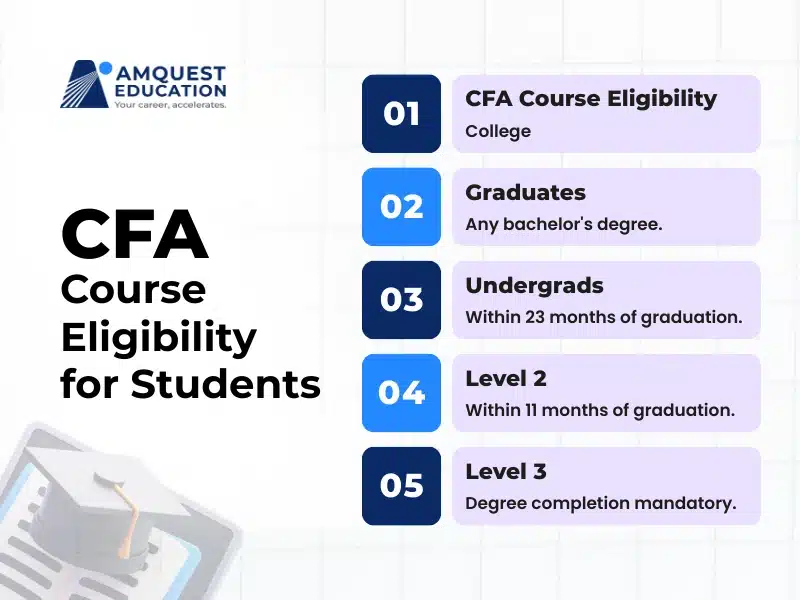
Students currently enrolled in a bachelor’s programme can register for Level 1 if their expected graduation date is within 23 months of the exam window they are targeting. A student in their second year of a three-year degree can typically meet this condition. No work experience is required if you are using the undergraduate route.
Graduates From Any Stream
Any candidate who holds a completed bachelor’s degree or its equivalent from a recognised institution can register for Level 1. The degree can be in any subject: engineering, arts, science, commerce, law, medicine, or anything else. There is no minimum percentage or marks requirement.
CA and MBA Students
CA students in India can register for CFA during their articleship period, provided they meet the undergraduate route (within 23 months of their graduation date from the degree programme they are simultaneously pursuing) or the work-experience route if they have accumulated 4,000 hours. CA, CS, and CMA qualifications alone do not substitute for a bachelor’s degree under CFA Institute’s rules. The charter itself requires a bachelor’s degree, so candidates relying on the work-experience route for exam entry must complete a degree before registering for Level 3. CFA after MBA is straightforward: MBA graduates hold a qualifying degree and can register for Level 1 at any time.
Working Professionals
Any professional who holds a bachelor’s degree can register regardless of how long they have been working. Those without a degree can use the 4,000-hour work-experience route. Work experience for exam entry can be from any industry and any function.
Non-Finance Professionals
Engineers, doctors, lawyers, teachers, and professionals from all sectors are eligible. CFA eligibility does not require prior finance experience for exam entry. Non-finance backgrounds are common at Level 1.
Candidates Planning a Finance Career Switch
CFA is one of the few credentials that accepts candidates from completely unrelated backgrounds. A software engineer or a pharmaceutical professional targeting investment analysis or portfolio management roles can begin CFA preparation and register for Level 1 without any prior finance work.
CFA Course Eligibility: Basic Requirements
Requirement | Detail |
Education | Bachelor’s degree in any subject from a recognised institution |
Undergraduate route | Enrolled in a degree programme within 23 months of graduation |
Work-experience route | 4,000 hours over at least 36 months (any industry) |
Passport | Valid international travel passport, mandatory for registration and exam day |
Age limit | None |
Entrance examination | None |
English proficiency | No formal test required. Exams are in English only |
Professional conduct | Agreement to CFA Institute Code of Ethics and Professional Conduct Statement mandatory |
CFA Course Eligibility: Basic Requirements
Not sure which eligibility route applies to you?
Talk to a counselor and confirm your CFA eligibility
CFA Eligibility Criteria for Each Level
Eligibility criteria for CFA differ by level. Level 1 has the most routes available. Level 2 and Level 3 become progressively more restrictive.
CFA Level 1 Eligibility Criteria
CFA Level 1 eligibility requires meeting one of the following four routes:
Route | Requirement |
Completed degree | Bachelor’s degree or equivalent from a recognised institution |
Undergraduate student | Currently enrolled and within 23 months of your expected graduation date |
Work experience | 4,000 hours of work experience over a minimum of 36 months (any industry) |
Combined route | Work experience and higher education combined totalling 4,000 hours over 36 months |
One year of higher education counts as 1,000 hours in the combined route. Work and education periods cannot overlap in the calculation. A valid international passport and a signed Professional Conduct Statement are also required.
CFA Level 2 Eligibility Criteria
CFA Level 2 eligibility requires having passed Level 1 and meeting one of:
- Already holds a completed bachelor’s degree or equivalent
- Undergraduate student within 11 months of expected graduation date
- Has accumulated 4,000 hours of work and/or education combination (achieved by the Level 1 registration date)
The undergraduate window tightens from 23 months at Level 1 to 11 months at Level 2. A student who registered for Level 1 with 18 months to graduation must be within 11 months by the time they register for Level 2.
CFA Level 3 Eligibility Criteria
CFA Level 3 eligibility requires having passed Level 2 and:
- A completed bachelor’s degree or equivalent
There is no undergraduate route at Level 3. Students who entered Level 1 on the undergraduate route must have completed their degree before registering for Level 3. Those who entered on the work-experience route must also hold a completed bachelor’s degree by Level 3 registration. The charter requires a degree, so this condition is enforced at the final level.
CFA Eligibility for CA, MBA and Working Professionals
CFA after MBA is one of the most direct routes. MBA Finance graduates hold a qualifying bachelor’s degree and can register immediately. Many pursue CFA alongside their MBA or immediately after to add technical investment depth to their management credential.
CA students in India raise a common question: whether their CA qualification substitutes for a bachelor’s degree. The answer is no. CFA Institute requires a bachelor’s degree from a recognised university or its equivalent. CA, CS, and CMA qualifications are professional credentials and do not by themselves satisfy the bachelor’s degree requirement.
However, a CA student who is simultaneously pursuing a BCom or equivalent degree can use the undergraduate route to register for Level 1 if they are within 23 months of graduation. CA students in their articleship period may also qualify under the work-experience route if they have accumulated 4,000 hours over 36 months, but they must still complete a bachelor’s degree before Level 3.
Finance professionals already working in banking, asset management, or wealth management qualify through the degree route if they hold a bachelor’s, or through the work-experience route if they do not. Many pursue CFA to move from support or operations functions into front-office investment roles.
CFA Eligibility Through Professional Work Experience
The work-experience route to CFA exam entry is frequently misunderstood. The experience does not need to be finance-related, but it must meet the hour and duration rules exactly.
Work Experience Requirements
The CFA Institute rule for exam-entry work experience requires at least 4,000 hours of professional work experience completed over a minimum of 36 consecutive months. The experience can be from any industry and any function. Paid full-time employment, paid part-time employment, paid internships, paid articleships, and paid work in a family-owned business all count. Remote work also qualifies. Unpaid internships and unpaid voluntary work do not count.
Rules for Full-Time vs Part-Time Work Experience
Full-time and part-time work both count toward the 4,000 hours, but they must be paid. The 36-month minimum is a duration floor, not a guarantee. A candidate working 20 hours per week for 36 months accumulates only 3,120 hours, which is below the 4,000-hour threshold. Part-time candidates need more than 36 months to meet both the hours and duration requirements.
For the combined route, one year of higher education equals 1,000 hours. Work and education periods must be non-overlapping in the calculation. A candidate who spent two years in postgraduate study (2,000 education hours) needs 2,000 more hours of work experience over the 36-month minimum.
CFA Exam Eligibility vs Work Experience Required for the Charter
Passing all three CFA exam levels does not make you a charterholder. There is a separate work experience requirement for the charter that is entirely different from the experience used for exam entry.
Work Experience Used for CFA Exam Eligibility
Experience used for exam entry can be from any industry, any function, and any type of paid work. A sales professional, a school teacher, or an IT analyst can each use their work experience to meet the 4,000-hour entry requirement. The work does not need to touch investment decisions.
Work Experience Required for the CFA Charter
Charter work experience is different. CFA Institute requires at least 4,000 hours completed over a minimum of 36 months that are directly related to the investment decision-making process, or that produce a work product that informs or adds value to that process. Generic work experience from non-investment roles does not qualify for the charter even if it was sufficient for exam entry.
Can the Same Experience Count for Both?
Yes, if the work is investment-related. A professional who spends 4,000 hours in equity research before entering the CFA Programme satisfies both the exam-entry requirement and part of the charter requirement with the same experience.
When Can Charter Work Experience Be Completed?
Charter work experience can be completed before, during, or after the three exam levels. CFA Institute allows candidates to apply for the charter once they have passed all three levels and accumulated the required experience, regardless of when those hours were earned relative to the exams.
Age and Other Key Requirements for CFA Eligibility
Two requirements apply to every candidate regardless of which eligibility route they use: the age rule (or absence of one) and the passport rule. Both are worth confirming before you start the registration form.
Minimum Age Criteria
There is no minimum age requirement for CFA eligibility. CFA Institute does not publish an age restriction. In practice, the youngest candidates are typically second-year degree students who meet the 23-month undergraduate rule.
Passport and Required Documentation
A valid international travel passport is mandatory for both registration and entry at the Prometric test centre on exam day. Aadhaar, PAN cards, driving licences, and voter IDs are not accepted. The name on your passport must exactly match the name entered in your CFA Institute account. An expired passport is not accepted even if all other details match.
Professional Conduct and Ethics Requirements
All CFA candidates must sign a Professional Conduct Statement at the time of registration. This is not optional. The statement commits candidates to CFA Institute’s Code of Ethics and Standards of Professional Conduct.
Candidates must also disclose any prior professional misconduct, criminal charges, or regulatory actions. CFA Institute reviews disclosures and may deny or revoke candidacy based on its professional conduct review process.
Continued adherence to the Code and Standards is required throughout candidacy and after earning the charter. Charterholders who breach the Code and Standards can have their designation revoked.
Country and Residency Requirements
CFA eligibility is available to candidates in most countries worldwide, but CFA Institute cannot offer its services in all regions. Candidates in countries subject to applicable trade sanctions or other restrictions imposed by US law may not be able to register, pay fees, or access study materials.
Before registering, candidates in any sanctioned or restricted region should check the CFA Institute website for the current list of affected countries. Payment method availability also varies by country. Prometric test centre availability differs by location. Indian candidates are not affected by these restrictions.
CFA Scholarship Eligibility
A CFA scholarship can significantly reduce the registration fee. Three scholarships are currently active. You must apply and receive approval before completing registration. Retroactive applications after paying the full fee are not accepted.
Scholarship | Fee After Award | Who Can Apply | Documents Required | When to Apply |
Access Scholarship | USD 400 per level | Any candidate demonstrating financial need | Application form and statement of need | Several months before each exam window; check cfainstitute.org for dates |
Student Scholarship | USD 600 per level | Students at CFA Institute affiliated universities who have not yet registered | Application through university’s affiliated faculty coordinator | Through university; not directly with CFA Institute |
Women’s Scholarship | Check cfainstitute.org | Women candidates; availability varies by cycle | Varies; check current CFA Institute scholarship page | Varies by cycle |
18% GST still applies for Indian candidates on the discounted fee amount, not the original full fee. After receiving a scholarship, you must complete registration within the allocated period or the award may lapse.
Common Myths About CFA Eligibility
Myth | What People Think | Reality |
CFA is only for commerce students | Arts, science, and engineering graduates cannot do CFA | Any degree from any stream qualifies. CFA Institute imposes no subject restriction |
Advanced mathematics is compulsory | You need strong maths to be eligible | No mathematical prerequisite exists for registration. The exam itself covers quantitative methods, but eligibility has no maths test |
Work experience is required before Level 1 | You must have work experience to start CFA | Work experience is one of three entry routes, not the only one. Degree holders and undergraduate students within 23 months of graduation need no work experience |
CFA has an age limit | There is a minimum or maximum age to register | CFA Institute publishes no age restriction |
You can start CFA immediately after Class 12 | Students can register right after finishing school | You must be enrolled in a degree programme and within 23 months of graduation. Class 12 graduates who have not yet enrolled in a degree cannot register |
Passing the exams makes you a charterholder | Clearing all three levels earns the CFA charter | You also need 4,000 hours of investment-related work experience over 36 months and professional references |
CFA Eligibility vs Other Finance Courses
Course | When You Can Start | Eligibility | Focus | Duration |
CFA | Within 23 months of graduation from a degree programme | Degree (any stream), final-year student, or 4,000 hours work experience | Investment analysis, portfolio management | 3+ years typically |
CA | After Class 12 | Class 12 pass in any stream | Accounting, audit, taxation, India-focused | 4-5 years |
MBA Finance | After a bachelor’s degree | Bachelor’s degree in any subject | General management with finance specialisation | 2 years full-time |
FRM | While in final year of a degree programme | No formal education requirement; any background | Financial risk management | 1-2 years |
ACCA | After Class 12 or with a degree | Class 12 pass or bachelor’s degree | Accounting, audit, global finance | 3-4 years |
CFA vs CA Eligibility
CA can be started after Class 12. CFA requires being in a degree programme within 23 months of graduation. CA is India-focused. CFA is globally recognised in investment roles. They complement each other well; many candidates pursue both.
CFA vs MBA Finance Eligibility
Both require a bachelor’s degree as a prerequisite. MBA Finance is a two-year full-time programme with broader management coverage. CFA is self-paced and can be completed while working. CFA after MBA is a common path for candidates wanting deeper investment specialisation.
CFA vs FRM Eligibility
FRM has no formal education prerequisite for registration. CFA requires a degree or 23-month undergraduate window. FRM covers financial risk specifically. CFA covers investment management broadly.
CFA vs ACCA Eligibility
ACCA can be started after Class 12, earlier than CFA. ACCA focuses on accounting and audit. CFA focuses on investment analysis. Both are globally recognised in their respective fields.
What’s Next After You Fulfil the CFA Eligibility Requirements?
Once you confirm you meet the CFA eligibility criteria, registration is the next step. Do not delay. Exam windows have fixed registration deadlines and Prometric test centre seats fill on a first-come, first-served basis.
- Create your CFA Institute account at cfainstitute.org using your exact passport name
- Choose your exam window based on how much preparation time you realistically have
- Check scholarship deadlines before paying the registration fee. Apply first if you qualify
- Register and pay the applicable fee. 18% GST is added at checkout for Indian candidates
- Immediately schedule your Prometric exam appointment after payment. Do not wait
- Log in to the CFA Learning Ecosystem to access the full digital curriculum, practice questions, and official mock exams
- Choose your study resources. The official curriculum is included free. Third-party notes and question banks are optional
- Create a week-by-week study plan working backwards from your exam window
- Begin preparation with foundational subjects and build progressively
When Is the Best Time to Start Preparing for the CFA Exam?
The answer differs by where you are in your studies or career. There is no single best time that works for everyone. What matters is matching your preparation window to an exam window where you have enough hours to study properly.
Best Time for Undergraduate Students
The best time to begin preparation is in your second or third year of a bachelor’s programme, once you are within 23 months of graduation and eligible to register. Starting early allows you to spread preparation across a longer period without the pressure of work commitments.
Best Time for Graduates
Register as soon as you graduate if you plan to sit for Level 1. Fresh graduates typically have fewer work commitments and more time to study. CFA Institute recommends at least 300 hours of study per level. That can be spread over six to twelve months of consistent preparation.
Best Time for Working Professionals
Working professionals should map their preparation around exam windows and their own peak work periods. November and February windows tend to be preferred by professionals who can use April to October for focused study. Avoid registering for a window that overlaps with audit season, year-end close, or other predictable high-pressure periods.
How Many Months of Preparation Are Required?
CFA Institute recommends a minimum of 300 hours per level. At 15 hours of study per week, that covers roughly 20 weeks or five months. Most candidates take six to twelve months for Level 1 and longer for Levels 2 and 3 as the material depth increases.
How to Select the Right CFA Exam Window
Work backwards from the exam date. Add your minimum study hours. Check whether your college or work schedule creates conflicts. Confirm the exam window is still open and that the curriculum year you are studying matches the window you target. November 2026 is the last window on the 2026 curriculum. Every window from February 2027 uses the updated 2027 curriculum.
CFA Course Duration and Fees at Amquest Education
CFA preparation at Amquest Education is structured around your specific exam window, not a fixed calendar. Study plans for Level 1, Level 2, and Level 3 are built around the actual exam date and the hours available per week. The programme covers all ten subject areas with faculty who have cleared the CFA themselves.
Contact us for current batch schedules, fees, and to confirm which window your preparation should target.
Final Thoughts
CFA eligibility in 2026 is genuinely open to candidates across all academic backgrounds and career stages. The three entry routes cover graduates, students within 23 months of graduation, and professionals with 4,000 hours of work experience. No stream restriction, no age limit, no entrance exam.
The most common mistake is confusing exam-entry eligibility with charter requirements. Passing the exams is necessary but not sufficient. You also need 4,000 hours of investment-related work experience over at least 36 months, separate from whatever got you into the programme. Sort that out early and your path to the charter becomes much cleaner.
FAQs on CFA Course Eligibility
What is the minimum education required for CFA eligibility in India?
A completed bachelor’s degree in any subject, or enrollment in a degree programme within 23 months of graduation. There is no minimum percentage or subject requirement.
Is work experience mandatory for CFA eligibility in India?
No. Degree holders and undergraduate students within 23 months of graduation need no work experience to register for Level 1. Work experience is only one of three entry routes.
Can final-year college students apply for the CFA Level I exam?
Yes, if their expected graduation date is within 23 months of the exam window they are targeting. This is the undergraduate route.
How can I register for the CFA exams in India?
Create an account at cfainstitute.org, confirm your eligibility route, select your level and exam window, pay the registration fee, and then separately schedule your Prometric appointment before the scheduling deadline.
What is the CFA exam fee in India?
USD 1,140 at early registration and USD 1,490 at standard registration for Levels 1 and 2. USD 1,240 early and USD 1,590 standard for Level 3. Indian candidates pay 18% GST on top, added at checkout.
Which is better: CFA or MBA?
They serve different goals. CFA is the stronger choice for investment analysis, equity research, and portfolio management roles globally. MBA Finance is better for general management, consulting, or corporate finance roles. Many candidates pursue both.
How many attempts are allowed for CFA exams?
A maximum of six attempts per level across your entire candidacy. You can sit the same level a maximum of twice per calendar year. Consecutive windows or windows less than six months apart are not permitted.
What career options are available after completing CFA?
Portfolio management, equity research, investment banking, credit analysis, risk management, wealth management, financial planning, and related roles in asset management, banking, and corporate finance.
Can CA, CS or CMA qualifications count as a bachelor’s degree?
No. CFA Institute requires a bachelor’s degree from a recognised university or its equivalent. CA, CS, and CMA are professional credentials and do not substitute. Candidates with these qualifications who also hold a bachelor’s degree qualify on the degree route.
Can I register for two CFA levels in the same exam cycle?
No. CFA levels must be completed sequentially. You cannot register for Level 2 until you have passed Level 1, and you cannot sit for two levels in the same exam window.
Can paid internships or articleships count toward eligibility?
Yes. Paid internships and paid articleships count toward the 4,000-hour work-experience route. Unpaid internships do not qualify.
Are there country restrictions for CFA registration?
CFA Institute cannot offer services in regions subject to applicable trade sanctions under US law. Candidates in affected regions may not be able to register, pay, or access study materials. Indian candidates are not affected. Check cfainstitute.org for the current list.
Can I apply for a CFA scholarship?
Yes. Three scholarships are currently active: the Access Scholarship (fee to USD 400), the Student Scholarship (fee to USD 600 for students at affiliated universities), and the Women’s Scholarship (availability varies by cycle). Apply before registering as retroactive applications are not accepted.
Who is eligible for CFA?
Anyone who holds a completed bachelor’s degree, is enrolled in a degree programme within 23 months of graduation, or has 4,000 hours of work and/or education over 36 months. No age limit, no stream restriction, no entrance exam.
When can I start the CFA course?
As soon as you are within 23 months of your expected graduation date while enrolled in a degree programme, or once you hold a completed bachelor’s degree.
When can I appear for CFA Level 1?
When your exam window falls within 23 months of your expected graduation date, or when you hold a completed bachelor’s degree, or when you meet the 4,000-hour work-experience route.
Is a passport required for CFA registration?
Yes. A valid international travel passport is the only accepted identity document for both registration and entry at the Prometric test centre on exam day. Aadhaar, PAN, and driving licences are not accepted.
Is there an exemption for CA students in CFA?
No. CA students have no special exemption or fast-track route. They must meet the same three entry routes as all other candidates: bachelor’s degree, undergraduate within 23 months, or 4,000-hour work-experience route.