In today’s hyper-competitive B2B landscape, sales teams face an overwhelming challenge: identifying which leads genuinely warrant pursuit versus those destined to consume precious time and resources. The problem is quantifiable and costly. Sales representatives waste approximately 40% of their time chasing leads that will never convert, resulting in bloated sales cycles, missed revenue targets, and frustrated teams. Traditional lead scoring methods—based on static rules and subjective assessments—fail to distinguish signal from noise.
Predictive lead scoring changes this equation entirely. By leveraging artificial intelligence and machine learning, organizations now analyze thousands of historical data points to identify patterns that predict conversion with remarkable accuracy. Rather than guessing which prospects matter most, sales teams work with precision, focusing energy where it generates measurable results. The impact is transformative: companies implementing AI-powered lead qualification report 20-30% improvements in conversion rates, 30-50% faster sales cycles, and conversion rate gains that translate into 10-20% revenue growth within the first year. This shift from intuition-based selling to evidence-based strategy represents one of the most significant operational transformations in modern go-to-market operations.
Understanding Predictive Lead Scoring: The Evolution from Manual to Intelligent Systems
For decades, organizations relied on manual lead scoring—spreadsheets, subjective assessments, and rules of thumb. Marketing teams assigned points for basic criteria: company size, industry vertical, job title. Sales teams then applied their judgment, often disagreeing with marketing on which prospects deserved attention. This approach worked at small scale but became a bottleneck as lead volumes grew.
Predictive lead scoring fundamentally reimagines this process. Rather than assigning fixed points based on assumptions, machine learning algorithms analyze your entire customer database to identify shared characteristics among leads that actually converted versus those that stalled. The system detects correlations humans would never spot—perhaps discovering that leads from specific industries with particular job titles who engaged with certain content types convert at three times the average rate.
The technology considers a remarkably comprehensive dataset: website behavior (time spent, pages visited), email interactions (opens, replies, clicks), CRM activity (past deals, sales conversations), purchase history, and engagement velocity. By aggregating hundreds of data points per contact record, AI lead qualification systems determine conversion likelihood with far greater accuracy than any individual sales representative could achieve.
What makes this approach powerful is its adaptability. Unlike static models that grow stale, predictive systems retrain regularly, incorporating new customer data and adjusting for shifting market conditions. Your lead qualification model doesn’t reflect yesterday’s customers—it evolves continuously to match today’s market realities.
The Business Case: Why Predictive Lead Scoring Matters
Organizations implementing predictive lead qualification experience measurable improvements across critical business metrics. Understanding these benefits clarifies why this technology has become essential rather than optional.
Dramatic Conversion Rate Improvements
When sales teams focus exclusively on prospects with genuine conversion potential, win rates climb sharply. Research shows companies using AI for lead scoring and targeting experience 20-30% conversion rate increases. This translates directly to revenue impact: organizations typically report 10-20% revenue growth in the first year while simultaneously cutting 60-80% of lead qualification costs.
Reclaimed Sales Productivity
Sales representatives typically spend 30-40% of their time on initial lead qualification alone. AI lead qualification cuts this burden dramatically, freeing reps to invest time in deeper discovery conversations, product demonstrations, and relationship building with genuine prospects. The result: sales teams report higher job satisfaction alongside measurable productivity gains.
Scalability Without Proportional Headcount Growth
Manual lead scoring requires hiring additional staff as volume increases. Predictive models scale infinitely—processing thousands or millions of leads consistently without requiring additional personnel. This near-infinite scalability proves particularly valuable for high-growth companies managing rapidly expanding lead volumes.
Revenue Forecasting Accuracy
Predictive lead scoring creates new organizational intelligence. Lead scores correlate with business metrics like ARR, MRR, Weighted Pipeline Value, and customer lifetime value, enabling companies to predict where these metrics will land six, nine, or twelve months into the future. This forecasting capability transforms how leaders allocate resources and plan growth initiatives.
Unified Sales and Marketing Strategy
When both teams operate from a single source of data-driven truth, collaboration improves dramatically. Marketing understands precisely which targeting strategies attract high-quality prospects. Sales provides feedback on lead quality to refine scoring criteria. This virtuous cycle drives continuous improvement and eliminates the friction that typically exists between departments.
How AI-Powered Lead Qualification Actually Works
Understanding the mechanics demystifies the technology and clarifies why it outperforms traditional approaches.
Data Integration and Enrichment
The system ingests data from multiple sources: your CRM, marketing automation platform, website analytics, email engagement systems, and third-party data enrichment providers. This comprehensive data collection creates rich buyer profiles extending far beyond traditional CRM boundaries. The more data sources you integrate, the more accurate your predictions become.
Pattern Recognition Through Machine Learning
Algorithms analyze historical data to identify shared traits among leads that converted versus those that didn’t. The system detects correlations that humans typically miss. Perhaps leads from SaaS companies with director-level titles who engaged with your ROI calculator and visited pricing pages twice convert at 5x the average rate. These insights become the foundation for your scoring model.
Predictive Model Development
Using identified patterns, the system creates and tests multiple predictive models, ultimately selecting the most accurate one. This model becomes your scoring engine, assigning each new lead a probability score reflecting their conversion likelihood. Unlike traditional scoring that provides a static number, predictive models provide context: why a lead scored high and what signals drove that score.
Continuous Learning and Refinement
As new customer data emerges, the model retrains, incorporating fresh insights and adjusting for market changes. This continuous improvement ensures your AI lead qualification system remains calibrated to current conditions rather than becoming stale.
Implementing Predictive Lead Scoring: Practical Tactics for Success
Integrate Multiple Data Sources Strategically
The richest insights emerge when combining CRM data, behavioral signals, intent data, and firmographic information. Companies leveraging external data enrichment sources alongside internal data typically see 20-30% improvements in scoring accuracy compared to those relying solely on CRM information.
Create Feedback Loops Between Sales and Marketing
Establish processes where sales teams regularly report on lead quality and conversion outcomes. This feedback directly improves model accuracy, creating a collaborative refinement cycle. When sales development representatives note that a lead scored high but lacked genuine buying intent, the model learns and adjusts accordingly.
Segment Models by Buyer Journey Stage
Not all leads are created equal. Implement separate scoring models for different stages—top-of-funnel awareness prospects score differently than mid-funnel evaluation-stage buyers. This nuanced approach dramatically improves accuracy and ensures appropriate prioritization across the entire pipeline.
Monitor Score Trajectories, Not Just Absolute Scores
Individual lead scores matter less than score trajectories. A prospect whose engagement is accelerating represents higher conversion potential than a stagnant lead, even if current scores are similar. Trend analysis reveals momentum and buying intent more accurately than snapshot scores.
Establish Clear Baseline Metrics Before Implementation
Document current performance before going live: conversion rates, sales cycle length, forecast accuracy, and cost per acquisition. These baselines make ROI measurement straightforward and help you demonstrate value to stakeholders within 60-90 days of implementation.
Real-World Impact: A B2B SaaS Transformation
Consider a mid-market marketing automation platform struggling with lead quality. Receiving 500+ leads monthly but converting only 8%, with average sales cycles stretching to 120 days, the company’s manual lead scoring relied on basic criteria: company size, industry, and job title. Sales teams spent enormous energy on prospects with minimal conversion potential.
The company implemented an AI-powered lead qualification system, integrating CRM data, website behavior, email engagement, and intent signals. Within three months:
- Conversion rate improved from 8% to 18% (a 2.3x increase)
- Average sales cycle compressed to 68 days (43% reduction)
- Sales team efficiency increased 35%, with reps spending more time on qualified prospects
- Revenue forecasting accuracy improved from 72% to 91%
The transformation didn’t happen instantly. Month one focused on training the model on historical data. Month two involved fine-tuning based on sales feedback. By month three, the system operated with high accuracy. The investment paid for itself within six months through improved conversion rates alone.
Measuring Success: Key Performance Indicators
Track these metrics monthly, comparing performance before and after implementation:
| Metric | Typical Baseline | Expected Improvement |
|---|---|---|
| Lead-to-Customer Conversion Rate | 8-12% | 15-25% |
| Average Sales Cycle Length | 90-120 days | 60-90 days |
| Sales Team Selling Time | 40-50% | 60-70% |
| Revenue Forecast Accuracy | 70-80% | 85-95% |
| Cost Per Acquisition | Baseline | 20-35% reduction |
| Pipeline Velocity | Baseline | 30-50% improvement |
Most organizations see meaningful improvements within 60-90 days as the model trains and teams adjust their processes.
Developing Expertise in AI-Powered Lead Qualification
Mastering predictive lead scoring requires understanding both the technology and its strategic application. For marketing and sales professionals seeking to develop this expertise, structured learning accelerates competency development. The Digital Marketing and Artificial Intelligence course at Amquest Education provides comprehensive, hands-on training bridging theory and practice.
Rather than abstract concepts, the curriculum focuses on practical AI applications in marketing—including lead scoring, customer segmentation, and campaign optimization. You learn by doing, working through real-world scenarios that mirror challenges you’ll face in your organization.
What distinguishes this approach: industry-experienced faculty bring years of hands-on experience implementing AI solutions at scale. They share real challenges, solutions that worked, and lessons learned—insights you won’t find in textbooks. The program includes internship opportunities with industry partners, giving you practical experience and potential employment pathways. As a Mumbai-based institution with national online availability, Amquest connects you with local industry networks while maintaining accessibility regardless of location.
Frequently Asked Questions
What is the difference between predictive lead scoring and traditional lead scoring?
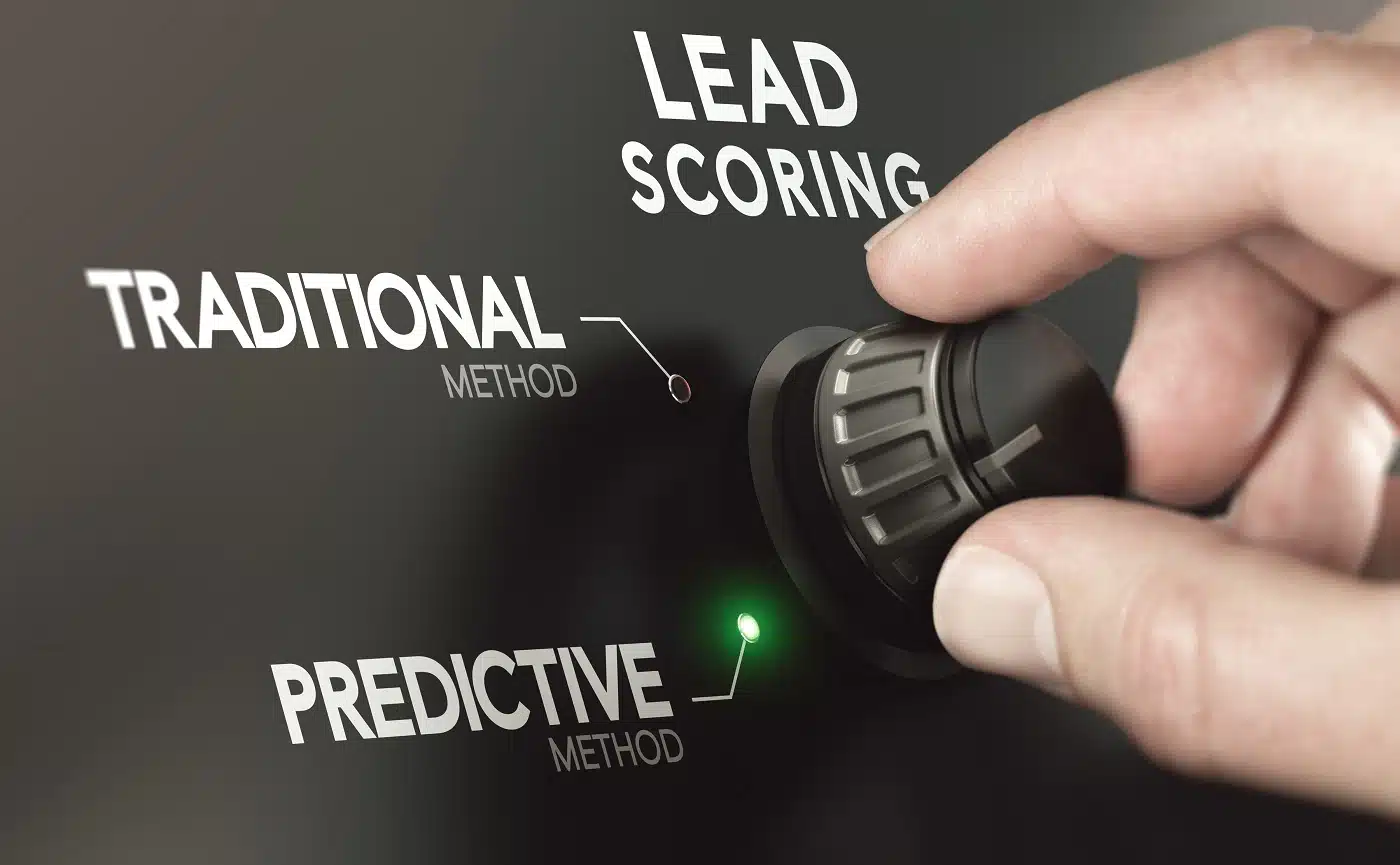
Traditional lead scoring relies on manually set criteria—assigning points for actions like email opens or website visits. Predictive lead scoring uses machine learning to analyze historical data and identify patterns that actually predict conversion. Unlike static rules, predictive models continuously learn and adapt based on real outcomes, delivering superior accuracy and requiring minimal manual adjustment.
How long does implementation take?
Setup and initial model training typically require 2-4 weeks. However, meaningful results usually emerge within 60-90 days as the system trains on your historical data and teams adjust processes. The first month focuses on data preparation and model training, the second on refinement based on sales feedback, and by month three, most organizations see significant performance improvements.
What data sources should we integrate?
Optimal results come from integrating CRM data, website analytics, email engagement metrics, marketing automation data, and third-party intent signals. The richer your data foundation, the more accurately the model identifies high-value prospects. Some platforms also leverage anonymous industry data to improve scoring when internal data is limited.
How do we measure ROI?
Track metrics like conversion rate improvement, sales cycle reduction, forecast accuracy, and cost per acquisition. Most organizations measure ROI by comparing these metrics before and after implementation. A typical mid-market company sees 20-50% improvements in conversion rates and 30-40% reductions in average sales cycle length within six months.
Can this work for B2C companies?
Absolutely. While B2B companies often have clearer buying signals, B2C organizations benefit equally from predictive lead qualification. E-commerce companies use it to identify high-lifetime-value customers; SaaS companies use it to predict trial-to-paid conversions; financial services firms use it to identify investment prospects. The underlying principles apply across industries.
Conclusion
Predictive lead scoring represents the frontier of modern sales and marketing operations. By leveraging machine learning to identify high-value customers with unprecedented accuracy, organizations dramatically improve conversion rates, compress sales cycles, and forecast revenue with confidence. The technology removes guesswork, scales effortlessly, and creates alignment between marketing and sales teams around data-driven truth.
The competitive advantage belongs to organizations embracing this transformation now. As AI lead qualification becomes standard practice, companies still relying on manual processes will find themselves increasingly disadvantaged. Whether you’re a marketer seeking to improve campaign targeting or a sales leader looking to optimize pipeline quality, understanding and implementing predictive lead scoring is essential.
To develop the expertise needed to lead this transformation, explore Amquest Education’s Digital Marketing and Artificial Intelligence course, where you’ll gain hands-on skills in AI-powered marketing strategies, including advanced lead qualification and customer scoring models. Start your journey toward mastery today.