

When a big Indian company decides to expand, they look for the types of investment banking services that provide the most capital. Today, modern investment banking means navigating the complexities of ESG (Environmental, Social, and Governance) mandates. Now, IB firms are the primary architects of green bonds and sustainable financing, ensuring that “value” is measured by environmental impact as much as it is by the bottom line.
Now that you know what investment banking means in the current landscape, keep reading this guide and explore the specific types of it.
Comprehensive Summary
- Investment Banking Meaning: acts as high-level intermediaries that help large-scale clients raise funds and execute strategic business deals like M&As.
- Categories of Investment Banks: Bulge Bracket (huge global banks), Middle Market (mid-sized firms), and Boutique (specialised experts).
- Types of Investment Banking Services: Mergers and Acquisitions (M&A), Equity Capital Markets (ECM), Debt Capital Markets (DCM), and Corporate Advisory.
- Top Players in India: Firms like Kotak Investment Banking, Avendus Capital, and global giants like Morgan Stanley lead the charge in the Indian financial space.
- Skills Needed for Success: You need strong math skills, a deep knowledge of financial markets, and the right certification to land a high-paying role.
Quick Question: Do you want to master the art of closing big deals?
Join our professional program today!
What is Investment Banking?
Investment banking is a specific part of banking that helps companies and governments raise money by selling securities or by giving expert advice on big financial moves. Instead of taking your personal deposits like a regular bank, these firms deal with millions and billions of rupees at a time. They act as a middleman between people who have money to invest and organisations that need money to grow.
Investment bankers are now helping companies navigate the complex world of ESG (Environmental, Social, and Governance) rules while they raise funds. With this, they also work on “Underwriting,” which means they take on the risk of buying shares from a company and then selling them to the public or other big investors.
The industry is divided into several areas. Some bankers work on the “Front Office,” where they talk to clients and close deals. Others work in the “Middle Office,” managing risks and making sure everyone follows the law. Then there is the “Back Office,” where all the technical support and data processing happen to keep the bank running smoothly.
Main Types of Investment Banking
When we talk about the different types of investment banking, we are usually talking about the size of the bank and the kind of clients they serve. Not every bank handles the same kind of deals. Some focus only on multi-billion-dollar global mergers, while others might focus on helping a small healthcare startup in Bangalore get its first round of major funding.
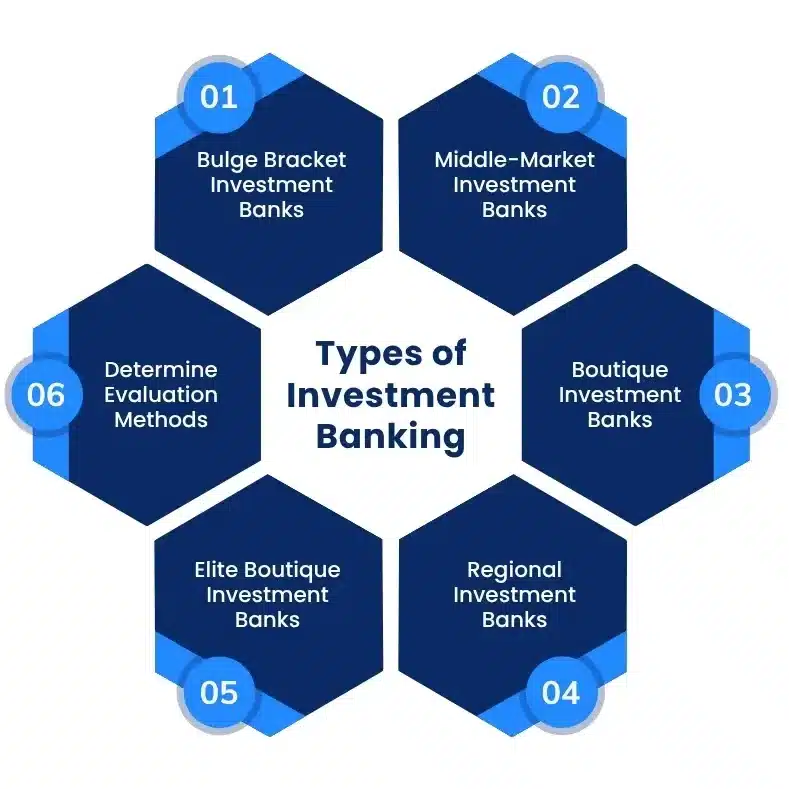
Bulge Bracket Investment Banks
These are the titans of the financial world. Bulge bracket banks are the largest global firms that have offices in every major city, from New York and London to Mumbai and GIFT City. They handle the biggest deals you see in the headlines. If a massive multinational company wants to buy another huge firm across the ocean, they call a bulge bracket bank.
In India, these banks are very active in 2026. They provide every possible service, from trading and research to wealth management and massive corporate loans. Because they are so big, they have thousands of employees and offer very high salaries, but the work is also very intense.
Middle Market Investment Banks
Middle market banks sit right in the centre. They work with companies that are bigger than a local shop but smaller than a global conglomerate. These firms usually handle deals ranging from ₹500 crore to ₹5,000 crore. They are very popular in India because most of our growing companies fall into this category.
Working at a middle-market bank is often seen as a great way to learn. You get to see every part of a deal because the teams are smaller than those at the giant banks. You aren’t just a small cog in a massive machine; you are right there in the room when decisions happen.
Boutique Investment Banks
Boutique banks are the specialists. They don’t try to do everything. Instead, they might only focus on one thing, like M&A, or one specific industry, like Renewable Energy or Fintech. Some are “Elite Boutiques,” which are smaller in size but handle deals just as big as the bulge bracket banks.
Others are “Regional Boutiques” that focus on a specific area, like South India or the North East. These firms are excellent if you want to become a deep expert in a particular field. They value specific knowledge over general skills.
| Bank Category | Client Size | Primary Focus | Examples in India |
| Bulge Bracket | Global Corporations | Large-scale M&A, IPOs | JP Morgan, Morgan Stanley |
| Middle Market | Mid-sized companies | Growth capital, Private Equity | Kotak, Axis Capital |
| Boutique | Specific Sectors | Niche Advisory, Restructuring | Avendus, Spark Capital |
Key Investment Banking Services Explained
Understanding the types of investment banking services is the first step to figuring out where you fit in. Each service requires a different mindset and a different set of skills. In 2026, these services will have become more tech-driven, using AI to predict market trends and find the best buyers for a business.
Mergers and Acquisitions (M&A)
Most people associate investment banking specifically with M&A. It’s the process of companies either being bought out (Acquisition) or teaming up to start fresh (Merger). As a banker, you’re the engine behind the deal; you figure out the company’s market value, hunt down potential buyers or sellers, and handle the high-stakes price negotiations.
According to data from the India Brand Equity Foundation (IBEF), deal-making in India has seen a 15% rise in early 2026 compared to last year. This is because many Indian founders are looking to exit their businesses, or larger firms want to expand their digital footprints.
Equity Capital Markets (ECM)
Companies seeking public capital partner with ECM specialists to launch an IPO. These experts ensure the entire process stays compliant with SEBI standards while fine-tuning the valuation to make sure the market actually buys the shares.
Debt Capital Markets (DCM)
Selling off company shares isn’t always the best move. Instead, many firms choose to borrow, using their DCM team to issue bonds. Think of these as professional “IOUs” sold to major investors. The company gets the capital today and pays it back with interest over time. Lately, in 2026, Green Bonds have exploded in India as the go-to way to fund new solar and wind farms.
Corporate Advisory Services
This is all about giving the best advice. Maybe a company is struggling with its finances and needs to restructure its debt. Or maybe they want to know if they should expand into a new country. Advisory services don’t always involve a specific transaction; sometimes, they are about long-term strategy and keeping the company healthy.
Sales and Trading
This is the part of the bank that looks like what you see in the movies, people watching screens and buying or selling stocks, bonds, or currencies. They do this for the bank’s clients or sometimes for the bank itself. They provide “Liquidity,” which means they make it easy for people to buy and sell assets whenever they need to.
Boost Your Career: Are you ready to dive into M&A and ECM?
Amquest Education offers the most practical IB Course.
List of Top Investment Banks in India
India has a mix of home-grown stars and international giants. If you are looking for a job or curious about who is running the show in 2026, these names are at the top of the list.
| Firm | Core Strength | Key Market Influence |
| Kotak Investment Banking | Local Expertise | The go-to for Indian IPOs and the local landscape. |
| Avendus Capital | Tech & Innovation | The undisputed leader in the tech and startup space. |
| Axis Capital | Corporate Relations | Powerhouse for large-scale debt and equity deals. |
| Morgan Stanley / Goldman Sachs | Global Reach | Facilitators for complex cross-border deals. |
| ICICI Securities | Massive Distribution | Huge reach across retail and corporate investors. |
The growth of investment banks in India is also moving toward GIFT City in Gujarat. Many firms are setting up units there to take advantage of the tax benefits and easier international trading rules. This has created thousands of new jobs for skilled professionals in the last two years.
How to Choose the Right Investment Banking Career Path
Navigating the finance world is tough, especially when you start asking what the types of investment banking career paths available are. The “right” one isn’t just about the prestige; it’s about finding a role that fits your personality and makes the daily grind actually worth it.
- If you love storytelling and strategy, M&A might be for you. You have to convince people why a deal makes sense and how two companies are better together.
- If you are a math wizard, DCM or Sales and Trading will suit you. These roles involve a lot of numbers, fast calculations, and understanding how interest rates affect the world.
- If you like the “big picture, Working in a Bulge Bracket bank gives you a view of the global economy.
- If you want to be a specialist, A Boutique firm lets you become the go-to person for a specific industry like Healthcare or AI.
In 2026, the competition for these roles is high. Just having a degree is often not enough. You need to show that you can do the work. This is where the Amquest Education IB Course comes in. It provides the hands-on training that banks are looking for today. You learn how to build financial models, value companies, and understand the latest SEBI rules.
Need Career Advice? Talk to our experts and find your perfect fit in finance.
Our IB course is designed for the 2026 market.
The Role of Technology in 2026 Investment Banking
We cannot talk about types of investment banking today without mentioning technology. In 2026, AI and data analytics have changed the game. Research that used to take three weeks now takes three hours. Investment bankers now use:
Generative AI for Pitching:
Bankers now use advanced AI tools to create pitch books and financial models in a fraction of the time. This allows teams to spend more hours building relationships with clients instead of manual data entry.
Real-time ESG Tracking:
With new sustainability rules in 2026, banks will use real-time data to track a company’s carbon footprint. This helps investors decide which “Green Bonds” are actually good for the planet and the portfolio.
Blockchain in Debt Markets:
Issuing corporate bonds is now much faster thanks to blockchain. It removes the need for heavy paperwork and makes every transaction visible and secure for both the buyer and the seller.
Predictive Deal Sourcing:
Algorithms now scan thousands of news reports, social media trends, and satellite images to find companies that might be ready for a merger. This gives bankers a head start before a deal even hits the public eye.
T-0 Settlement Speeds:
You know how India’s been leading the charge in fast trading? Well, by 2026, stock trades are going to be pretty much instant. It’s a huge deal for bankers because their tech has to be fast enough to keep up with billions of dollars moving around in the blink of an eye.
Cybersecurity in GIFT City:
As more firms move to Gujarat’s tech hub, they are using advanced encryption to keep client secrets safe. Protecting data has become a top priority to maintain trust in digital-first banking.
Virtual Deal Rooms:
The era of the 15-hour flight for a two-hour meeting is finally over. High-end virtual suites have become so seamless that CEOs in Mumbai and New York can now ink billion-dollar deals without ever needing a passport.
The Life of an Investment Banker in India
What does a typical day look like? It is definitely not a 9-to-5 job. It often starts early with a look at the global markets and ends late with calls to clients or finishing a “Pitch Book.” A pitch book is a presentation that shows a client why they should hire your bank for a deal.
While the hours are long, the rewards are also quite high. You get to work with the smartest minds in the country and see the results of your work in the news. There is a great sense of pride in seeing a company you helped go public and grow into a household name.
Take the First Step: Don’t just watch from the sidelines.
Get the skills to join the top 1% of finance professionals.
Conclusion
Deciding which of the types of investment banking to pursue is a choice that will shape your entire professional life. The Indian financial sector in 2026 is full of energy, and there is space for everyone from the math-heavy trader to the strategy-focused advisor. The key is to look at where the market is going, toward GIFT City, toward green energy, and toward digital-first deals. If you align your skills with these trends, you will find yourself in high demand.The path to the top is rarely a straight line, but it always starts with a solid foundation of knowledge. Whether you choose to work at a giant global bank or a nimble local boutique, the experience you gain will be priceless. If you are ready to take that leap and want to make sure you have the best training possible, the IB Course at Amquest Education is ready to help you get there. Start your journey now and be a part of India’s golden age of finance!
Final Call to Action: Your future in finance is waiting.
Enrol in the Amquest Education IB Course and get ahead.
FAQs on Types of Investment Banking
What are the four main areas of investment banking?
The four primary areas are Capital Markets (raising money), Mergers and Acquisitions (buying/selling businesses), Sales and Trading (buying/selling stocks/bonds), and Asset Management (managing client wealth).
What is the highest-paid job in investment banking?
If you want to see the highest earners this year, look at M&A heads and specialised traders. Between their base pay and bonuses, they’re easily pulling in several crores annually.
Who earns more: a CA or an investment banker?
While a CA career offers excellent financial stability, the earnings are often higher in investment banking because their performance-linked payouts can be significantly more aggressive.
Is an MBA or a CA better for investment banking?
Both are valued, but an MBA from a top school is often preferred for front-office deal-making, while CAs are highly respected for their technical and valuation expertise.
What does an investment banker do?
An investment banker acts as a financial advisor to corporations and governments, helping them raise money, manage big deals, and navigate complex financial regulations.