

India’s middle class growth still links closely to software engineer jobs, with NASSCOM estimating 5.80 million tech workers and 126,000 new roles in FY2025. In February 2026, Glassdoor’s India data places the Software Engineer pay range at ₹4.82L (25th percentile) to ₹14.0L (75th percentile) and ₹24.0L (90th percentile), which shows how wide the market gets once skills and company type come into play.
Now, let’s break down everything, including the path into role choices, skill blocks, salary bands, hiring companies, and future shifts.
Comprehensive Summary
- Software engineer meaning: This means a professional designing, building, testing, and maintaining software systems with engineering discipline and quality standards.
- Software engineer jobs in India: You will find these jobs mainly in product firms, IT services, startups, and GCCs, hiring for web, mobile, cloud, and platform work.
- What does a software engineer do: The role may differ by field, but it always involves building features, fixing bugs, managing services, and keeping systems secure and stable.
- Software engineer salary in India: Glassdoor shows around ₹8.6 LPA as the average software engineer salary in India, with higher pay for senior roles that carry more responsibility.
- Software Engineer Skills: Hiring teams first check your coding basics, DSA, databases, Git, and problem-solving, and then confirm your skills through projects and interviews.
- Software engineering Future opportunities AI tools, cloud adoption, and platform engineering keep expanding the role mix, and GitHub reported India added 5.2 million developers in 2025, showing the scale of the talent wave.
Which Engineering Path Fits Your Passion?
Whether you love Front-End, Back-End, or Full-Stack, we have a roadmap for you. Explore our syllabus to see how we train you for the specific role you want.
Understanding Software Engineer Jobs
Software engineering looks broad from the outside, but most teams hire for a simple outcome: reliable software that solves a business problem. That outcome can mean a customer-facing app, a payment service, a data pipeline, or a cloud platform. The work changes by product and team, but the success metrics stay clear, including shipping, uptime, performance, and secure handling of data.
In day-to-day terms, software engineers build systems that keep running after release. That means clean code, tests, monitoring, and fast fixes when production breaks.
What Does a Software Engineer Do?
Most teams expect the same core duties, even when the domain changes. You will see these tasks in job descriptions across product firms, IT services, startups, and GCCs.
Software engineer job responsibilities in real teams include:
- Writing production code that meets style, security, and performance standards.
- Reviewing peer code and pushing for clean interfaces and readable logic.
- Designing APIs and data flows that stay stable as usage grows.
- Fixing bugs and reducing recurring incidents through root-cause work.
- Writing tests, adding logs, and setting up alerts for reliability.
- Collaborating with product, design, QA, and DevOps for release readiness.
Different Types of Software Engineering Jobs
The fastest way to choose a path is to pick the layer you like working on. Some engineers like UI and UX. Some like server logic and performance. Some like infrastructure and reliability. Many move across layers over time.
The role list below follows the paths that show consistent demand on Indian job boards in 2025 and 2026.
Front-End and Back-End Developer Roles
Front-end roles are very accessible and somewhat easy, and on the other hand, back-end roles are more based on data, services, and performance. Many companies hire both, then add full-stack roles for speed.
Front-end work tends to centre on React, TypeScript, UI state, and web performance. Back-end work tends to centre on APIs, databases, caching, queues, and observability.
Front-End Developer role snapshot
- Core work: UI components, routing, state, accessibility, performance budgets.
- Typical tech used: React, TypeScript, Next.js, REST or GraphQL APIs, and testing tools.
- Live role listings: Front-end openings in India.
Back-End Developer role snapshot
- Core work: API development, access control, database planning, caching for speed, scheduled jobs, and reducing delays.
- Common stack: Java/Spring, Node.js, Python, Go, SQL, Redis, Kafka.
- Live role listings: Back-end openings in India.
Full-Stack Developer Career Roles
Full-stack roles suit candidates who like shipping end-to-end features. Many startups and mid-sized product teams hire full-stack engineers to keep squads lean. Full-stack interviews test your front-end basics, back-end design, database modelling, and debugging skills.
Full-Stack Developer role snapshot
- Core work: building features across UI, API, and database.
- Common stack: React + Node/Java/Python + SQL + cloud deployment basics.
- Live role listings: Glassdoor full-stack openings in India.
Mobile Application Developer Careers
Mobile roles continue to grow because most Indian users access products through phones. Android leads in volume, while iOS stays relevant for high-spending users and global apps. The work also involves speed, offline use, crash tracking, and smooth app releases.
Mobile Application Developer role snapshot
- Core work: Android/iOS features, app performance, crash fixes, analytics, and release cycles.
- Common stack: Kotlin/Java, Swift, Flutter/React Native (some teams).
- Live role listings: Indeed mobile application developer openings in India.
DevOps Engineer Job Roles
DevOps roles became common as companies adopted CI/CD, containers, and infrastructure as code. These engineers keep systems stable, push faster releases, and handle automation, cloud setup, monitoring, and production issues.
DevOps Engineer role snapshot
- Core work: Managing CI/CD, preparing container deployments, automating cloud setup, tracking system health, and following incident response steps.
- Common stack: Linux, Docker, Kubernetes, Terraform, GitHub Actions/Jenkins, cloud services.
- Live role listings: New DevOps engineer openings in India.
Cloud Engineering Career Opportunities
Cloud engineers set up and manage the online systems where companies keep their apps and data. They make sure these systems can grow, stay safe, and don’t cost too much money.
In 2025, NASSCOM’s Strategic Review noted enterprise momentum for technology spend with AI-led digital spend, with 82% of CXOs expecting to raise digital spend by 5%+ compared to the prior year. That enterprise spending creates more cloud work across sectors.
Cloud Engineer role snapshot
- Core work: cloud provisioning, IAM, networking, autoscaling, cost controls, and reliability.
- Common stack: AWS/Azure/GCP, Terraform, Kubernetes, observability tools.
- Live role listings: Top cloud engineer openings in India.
Are Your Software Engineering Skills 2026-Ready?
Don’t get stuck in the screening round. Master Data Structures, Algorithms, and System Design with the hands-on mentorship that top product firms demand.
Essential Skills Needed for Software Engineer Jobs
Skills decide shortlisting, but skills also decide your day-to-day comfort after joining. Many candidates chase tool names. Hiring managers care more about problem-solving, clean code, and the ability to learn new stacks.
Stack Overflow’s 2025 Developer Survey gives a useful market signal: 84% of respondents use or plan to use AI tools in their development process, and 51% of professional developers use AI tools daily. That means teams now expect engineers to work with AI copilots without losing engineering rigour.
Programming Languages
Pick one language for depth, then add one for breadth. Depth means you can build systems, not just solve coding puzzles.
- For backend depth: Java, Python, Go, or Node.js.
- For front-end depth: JavaScript/TypeScript.
- For mobile depth: Kotlin or Swift.
- For data-heavy roles: Python plus SQL.
Hiring teams also care about code clarity: naming, function boundaries, error handling, and testability.
Knowledge of Data Structures and Algorithms
DSA is usually at the centre of interview filters in India, especially for product firms and high-growth startups. You do not need theory talk. You need problem-solving speed and correctness. Focus on:
- Arrays, strings, hashing, stacks, and queues.
- Trees, graphs, recursion, and dynamic programming.
- Time and space complexity reasoning.
This skill also improves day-to-day work: debugging, performance tuning, and writing safer code.
Understanding Database Systems
Knowing all about the databases is a core skill most CVs lack. Even front-end engineers benefit from solid database basics because they work with APIs and data flows. Learn these foundations:
- SQL basics, joins, indexes, transactions.
- Data modelling and normalisation.
- Query performance and explain plans.
- NoSQL patterns for high-scale use cases.
Version Control Tools
Version control is also another very crucial skills and teams use Git for collaboration, code review, and release discipline.
Show these abilities in interviews:
- Clean commits with readable messages.
- Branching and merging with fewer conflicts.
- Pull requests with self-review notes.
- Basic GitHub workflows and CI hooks.
Strong Problem-Solving and Logical Skills
This skill blends everything above into one hiring signal: you can take an unclear problem and deliver a stable solution. Plus, strong engineers:
- Ask clear questions before coding.
- Break work into small, testable steps.
- Use logs and metrics to confirm assumptions.
- Write post-incident notes that prevent repeats.
This also ties into software engineer job responsibilities in real teams because engineers own fixes, not just features.
Software Engineer Salary in India – Overview
Pay varies by city, company type, and the level of system ownership. Public salary datasets still help set realistic bands. As per Glassdoor’s India pages, updated through Feb 2026, shows:
- The average software engineer’s pay is around ₹8.6 LPA
- A senior software engineer’s average pay is around ₹13 LPA
- A trainee software engineer’s average pay is around ₹4.5 LPA
Use these as directional markers, then map your offer to role scope and interview level.
Level | Common title examples | Pay anchor (India) | Source |
Entry | Trainee / Junior / SDE-1 | ~₹4.5 LPA avg | |
Mid | Software Engineer / SDE-2 | ~₹8.6 LPA avg | |
Senior | Senior Software Engineer / SDE-3 | ~₹13 LPA avg |
This section covers software engineer salary in India in a way you can use for planning, but your final number will track your interview level and the firm’s pay bands.
Entry-Level Software Engineer Pay
Early pay depends on hiring route: campus, off-campus, referral, or bootcamp placements. The band also depends on whether the role is product engineering or service delivery.
A good way to frame entry pay:
- Entry roles in services and support-heavy teams: lower bands.
- Entry roles in product and platform teams: higher bands.
- Entry roles tied to AI, cloud, or DevOps: higher bands when skill proof is strong.
If you target an Entry-level software engineer job, build a portfolio that shows real engineering habits: a clean repo, tests, a README, and a deploy link.
Mid-Level Software Engineer Compensation
Mid-level pay rises when the engineer owns a service or a key feature area. Ownership means you debug production, improve performance, and coordinate releases.
A strong mid-level engineer:
- Drives small design decisions.
- Improves developer experience with tooling.
- Writes tests and stabilises flaky systems.
- Mentors juniors in code reviews.
This is where the software engineering job salary starts tracking impact, not tenure.
Senior Software Engineer Salary Range
Senior pay rises when the engineer shapes architecture and reduces risk. Senior engineers design systems that scale and keep working under load.
Glassdoor’s senior engineer page shows a base pay range in India that spans wide bands, with a large sample size on the page.
Senior engineers get paid for:
- System design and trade-offs.
- Reliability, observability, and incident handling.
- Security awareness and data handling discipline.
- Mentoring and raising team quality.
This also ties directly into software engineer job role expectations at higher levels.
Top-Paying Software Engineering Positions
Top pay tends to show up in roles that combine deep technical scope with business impact. In India, the biggest jumps show up in:
- Senior engineers in product firms with high-scale systems.
- Platform engineers and SREs who keep systems stable.
- Cloud and DevOps engineers who reduce downtime and release cycles.
For a view of SRE demand, LinkedIn lists large volumes of site reliability engineer openings in India.
How to Land a Software Engineer Job
A job offer follows a pattern: skill proof → shortlisting → interviews → offer negotiation. The path feels hard when you treat it like a checklist. It feels manageable when you treat it like a pipeline with weekly output.
This section stays practical because candidates ask for a clear plan for software engineer jobs in India.
Required Education and Degree Options
Companies hire from multiple education routes in 2025 and 2026:
- B.E./B.Tech in CS/IT and related branches.
- BCA/MCA.
- Non-CS degrees with strong project proof and interview performance.
Many companies look at your degree first, yet they select you based on your skills and projects.
Certifications and Online Learning Programs
Certifications help when they map to job tasks. Cloud certs help with cloud roles. DevOps certs help for DevOps roles. DSA training helps with coding rounds.
Many students choose Amquest Education because it gives a structured learning plan. Its Software Engineering, Generative AI and Agentic AI program shows a 97% placement rate and an average starting salary of ₹12–18 LPA. The training combines full-stack development, GenAI workflows, mentor support, and practical projects that align with current tech hiring in India.
Creating a Strong Project Portfolio
A portfolio should prove two things: you can build, and you can ship.
A hiring-ready software engineer portfolio includes:
- 2–3 projects with real users or a realistic scope.
- A deployed link and a working demo video.
- A README that explains features, architecture, and trade-offs.
- Tests, linting, and clear commit history.
- A short “what I learned” section.
Project ideas that interviewers respect:
- Expense tracker with auth, DB, and analytics.
- E-commerce backend with carts, orders, and payments mock.
- Chat app with websockets, caching, and rate limits.
- A monitoring panel that shows logs and sends alerts for issues.
Preparing for Coding and Technical Interviews
Since AI tools are everywhere, you need to show you can write clean code and make good choices to stand out in an interview.
Most interviews in India follow a similar structure:
- Online assessment (DSA).
- Machine coding or take-home.
- System design (for mid/senior).
- Behavioural round.
Preparation that pays off:
- 150–250 DSA problems across core patterns.
- Weekly machine coding practice with time limits.
- Learn how APIs work, how caching speeds things up, how queues handle load, and how databases are split to scale.
Leading Companies Hiring Software Engineers
Hiring demand in 2025–26 comes from three clusters: product firms, IT services, and startups plus MNC GCCs. Each cluster hires differently and tests differently.
Product-Based Technology Companies
Product firms tend to test DSA, system design, and project depth. They hire for long-term ownership.
Examples of where the listings show up:
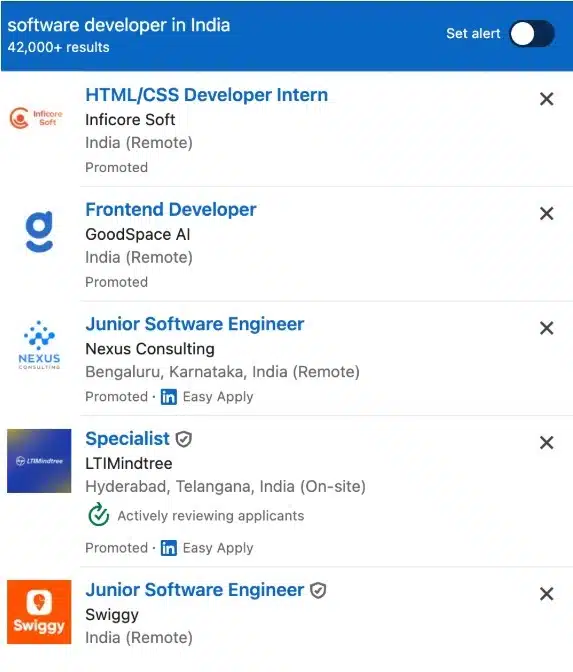
- If you’re looking for software roles in India, your best bet is to stick to the big four: LinkedIn, Naukri, Indeed, and Glassdoor. They all list the top-tier product companies and tech giants.
Service-Based IT Organisations
Service firms hire at scale and give broad domain exposure. The work can span modern stacks, but project quality varies by account and team.
Service firm interviews often test:
- Coding basics and problem-solving.
- Stack basics (Java/Python/JS + DB).
- Communication and client readiness.
Opportunities in Startups and MNCs
Startups recruit for momentum; MNCs recruit for scale and deep expertise.
Two signals worth noting:
- The “Top Startups” list on LinkedIn showcases high-growth, tech-focused firms that are actively recruiting engineers.
- A Reuters report (Feb 2026) said UBS planned to hire up to 3,000 roles in India with a new site in Hyderabad, with roles tied to technology and AI capabilities. That kind of GCC expansion lifts demand for engineers across levels.
This hiring spread is why Software engineer jobs remain a durable category across cycles.
Future Scope of Software Engineering Careers
Over the next two years, AI will become a regular part of coding, cloud and platform roles will grow, and remote hiring will continue, while India’s massive developer base reported in GitHub’s 2025 Octoverse keeps feeding new talent into the 2026 job market.
Rising Demand for AI and Cloud Specialists
- NASSCOM’s 2025 Strategic Review reports that CXOs plan higher digital spending, with AI driving a large share of that investment.
- Stack Overflow’s 2025 survey shows AI tools have become mainstream in development workflows.
- LinkedIn’s “Jobs on the Rise 2026” list highlights AI-linked roles as fast-growing in India.
In day-to-day hiring, this demand shows up in the volume of cloud engineer job listings in India.
Growth of Remote Software Engineering Jobs
Remote work did not vanish. It became role-dependent. Many firms run hybrid setups. Some startups hire fully remote for speed.
Remote readiness depends on:
- Strong written communication.
- Clear task updates and ownership habits.
- Handle async code reviews and releases.
- Discipline with documentation.
Candidates who can show these habits tend to do better in interviews for software engineer jobs in India that include distributed teams.
International Career Opportunities
International roles open up through two routes:
- Joining India teams of global companies, then moving internally.
- Building a strong portfolio and interview skills, then applying abroad.
A public example of global pay variation came from reporting on salary filings for software engineers in the US under H-1B/O-1, where pay can run very high at top firms. Your India career can still benefit from global exposure through cross-border teams, even without relocation.
This is also where a strong software engineer career plan matters: pick a domain, build depth, then scale breadth.
Pros and Challenges of Software Engineering Jobs
Software engineering pays well and stays resilient, but it also demands constant learning and steady problem-solving. A clear view helps you decide if the role fits your work style.
Side | What you gain | What you face |
Career value | High demand across sectors, clear growth ladders | Skill expectations rise each year |
Compensation | Strong upside with scope and impact | Pay varies by firm type and interview level |
Work nature | Building real products feels rewarding | Production incidents and deadlines create pressure |
Learning | New tech keeps work fresh | Continuous upskilling becomes part of the job |
Mobility | Many paths: web, mobile, cloud, data, platform | Switching paths needs portfolio proof |
Final Thoughts
A software engineering career continues to offer steady hiring and long-term growth in 2025 and 2026. Employers look for people who ship working code and handle production problems with confidence. Recent salary figures show income growing with ownership and impact. Choose a specialisation and align your portfolio with it.
If you want guided structure instead of trial-and-error, explore Amquest Education’s software engineering and AI programs, then compare the syllabus with the roles you want. Their program page lists placement outcomes, fresher CTC ranges, and a project-led learning path, which helps you plan with fewer guesswork loops. If you are ready to start, book a counselling call, share your background, and ask for a roadmap to your first offer.
FAQs on Software Engineer Jobs
What Is the Actual Salary of a Software Engineer?
Indian software engineering professionals generally see an average pay of ₹8.6 LPA, though this figure fluctuates based on the specific region and how well you navigate the interview process.
Who Earns More – A CA or A Software Engineer?
Your pay follows your job path and level; product engineers often see quicker hikes, whereas CAs reach high income in finance leadership roles.
What Qualifications Are Required to Become a Software Engineer?
Most companies accept a CS/IT degree or strong project proof with coding fundamentals, even from non-CS backgrounds.
Who Is Eligible to Apply for Software Engineer Jobs?
Freshers, career changers, and experienced professionals can apply when their skills and projects align with the software engineer role they want.
What Are the Basic Responsibilities of a Software Engineer?
A software engineer builds new features, resolves defects, writes tests, keeps the code clean, and works closely with product and QA teams.
How Do I Get an Entry-Level Software Engineer Job in India?
Build 2–3 deployable projects, strengthen DSA basics, and practice machine coding because many entry roles filter on these before interviews.
Which Skills Matter Most for Software Engineer Jobs in India in 2026?
Hiring teams prioritise DSA, one strong language, SQL basics, Git workflows, and practical project work that shows you can ship code.
Which Software Engineering Role Pays the Most in India?
Engineers earn the top packages in product, cloud, and SRE positions where they manage large systems and keep them running smoothly.
Are Software Engineer Jobs in India Good for Career Switchers?
Career switchers can enter software engineer jobs in India if they present strong projects, stay consistent with coding, and prepare well for interviews.
Do Certifications Help in Software Engineer Jobs?
Certifications help when they match the job track, like cloud certs for cloud roles or DevOps certs for CI/CD and infrastructure roles.
What is the job of a software engineer?
It is to ship software that works, keeps working, and stays safe for users and the business.