

Deciding between CFA vs CA is one of the biggest choices you will make if you want a top-tier career in finance or accounting. This decision shapes your daily work life, your paycheck, and where in the world you can work. While a Chartered Accountant (CA) is the backbone of Indian business audits and taxes, a Chartered Financial Analyst (CFA) is the master of the global investment world.
By 2026, India’s finance world looks totally different because so many people now want jobs that take them overseas. Whether you want to sign off on a company’s balance sheet or manage a billion-dollar investment fund, you need to know which path matches your dreams. This guide breaks down every detail you need to know about these two prestigious designations.
Comprehensive Summary
- Difference Between CA and CFA: A CA acts as a guardian of a company’s financial records, while a CFA acts as an architect for a client’s investment future.
- CA vs. CFA: Which is Better? For those aiming for a career in the “Big Four” accounting firms, CA is essential; for those aiming for Wall Street or Dalal Street, CFA is the gold standard.
- CFA Program: This course allows students to begin their professional journey during their final year of graduation, providing an early start in the finance industry.
- Is CFA Harder than CA: While CA demands an incredible memory for Indian tax laws and auditing standards, the CFA program tests your ability to solve high-pressure, multi-step financial problems and understand global market movements.
- CFA vs. CA Salary: In the current 2026 economic climate, dual-qualified professionals (CA + CFA) command the highest premiums in the Indian job market.
Not sure if you’re a “CA person” or a “CFA person”?
Speak with an industry expert who can map your strengths to the right career.
Understanding the Difference Between CFA and CA
The main difference lies in their core focus. Think of a CA as the person who looks at what a company did in the past to make sure everything is legal and accurate. On the other hand, a CFA looks at what a company might do in the future to help people invest their money wisely.
- CA focus: Tax, audit, law, and accounting.
- CFA focus: Investments, stocks, bonds, and portfolio management.
While both titles command respect, the CA is governed by the Institute of Chartered Accountants of India (ICAI), while the CFA is a global program from the CFA Institute in the USA.
What Is CFA (Chartered Financial Analyst)?
The CFA course full form is Chartered Financial Analyst. It is a professional credential that tells the world you are an expert in investment analysis. If you see someone with “CFA” after their name, you know they have passed three incredibly hard exams and have the work experience to manage serious wealth.
Why Choose the CFA Program?
You should pick the CFA program if you love the stock market. It gives you a “global passport,” meaning your skills are recognized in over 160 countries. In 2026, as India’s stock market continues to grow, the demand for CFA in India has reached an all-time high. It’s perfect for those who want to work in investment banking, hedge funds, or wealth management.
Want to master the markets?
Get expert guidance and 2026-ready study materials for your CFA journey.
What Is CA (Chartered Accountant)?
A Chartered Accountant is a professional who handles the financial health of an organization. They are the only ones in India authorized to audit financial statements. This role is deeply rooted in Indian law and the Companies Act.
Key Benefits of Becoming a CA
Becoming a CA gives you job security like almost no other profession. Every registered company in India needs a CA for their audits and tax filings. It allows you to start your own practice, work for the “Big Four” accounting firms, or lead the finance department of a major corporation. The prestige of a CA in Indian society is unmatched.
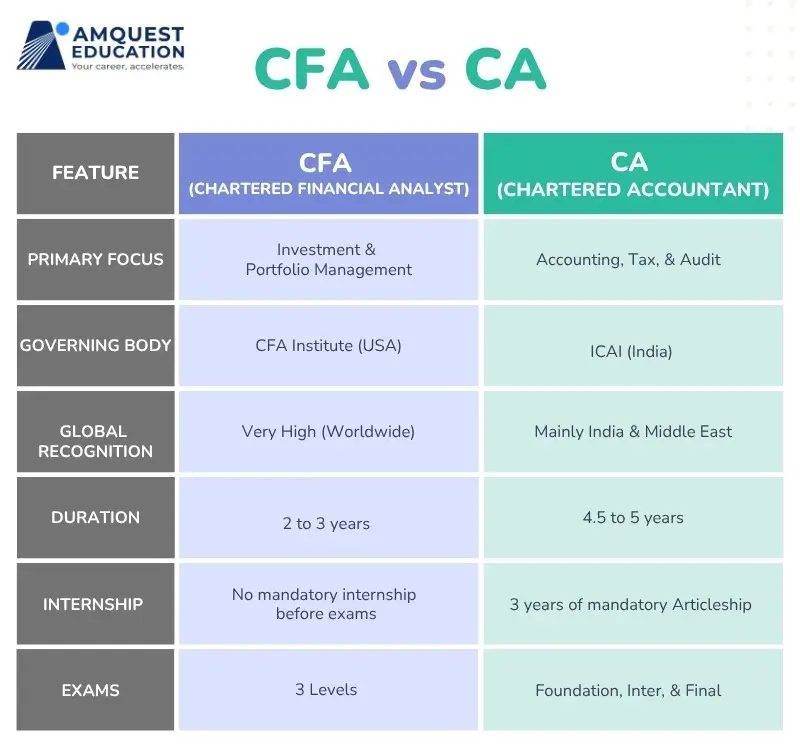
CFA vs CA: Major Differences Explained
| Feature | CFA (Chartered Financial Analyst) | CA (Chartered Accountant) |
| Primary Focus | Investment & Portfolio Management | Accounting, Tax, & Audit |
| Governing Body | CFA Institute (USA) | ICAI (India) |
| Global Recognition | Very High (Worldwide) | Mainly India & Middle East |
| Duration | 2 to 3 years | 4.5 to 5 years |
| Internship | No mandatory internship before exams | 3 years of mandatory Articleship |
| Exams | 3 Levels | Foundation, Inter, & Final |
CFA vs CA: Course Syllabus and Subjects
The subjects you study will define your mindset. CA students spend years memorizing tax codes and audit standards. CFA students spend their time calculating the value of a business and understanding how global economies interact.
Subjects Included in the CFA Program
The CFA details regarding the syllabus are consistent across all three levels, but the depth increases.
- Ethical and Professional Standards
- Quantitative Methods (Math for finance)
- Economics
- Financial Statement Analysis
- Equity Investments (Stocks)
- Fixed Income (Bonds)
- Derivatives and Alternative Investments
- Portfolio Management
Subjects Included in the CA Program
The CA syllabus is massive and covers everything needed to run a business in India.
- Advanced Accounting
- Corporate and Economic Laws
- Taxation (Direct and Indirect)
- Cost and Management Accounting
- Auditing and Assurance
- Financial Reporting
- Strategic Financial Management
Ready to start your CFA journey?
Lock in your seat for our upcoming batch and get early access to our premium 2026 question bank and mock tests.
CFA vs CA: Comparing Course Duration
Time is your most valuable asset. If you start right after your 12th grade, the CA path will take you about 5 years. This includes the mandatory 3-year articleship where you work under a senior CA. It is a long, hard grind that requires a lot of patience.
The CFA certification is faster. You can start appearing for Level 1 in your second year of college. Many students finish all three levels in 2 to 2.5 years. However, you still need 4,000 hours of relevant work experience to officially call yourself a CFA charterholder.
CFA vs CA: Career Opportunities and Salary
When it comes to CFA vs. CA salary, both offer a great life. However, the types of companies that hire them are different.
CFA vs CA: Course Fees 2026 Comparison
Money matters. The cost of these courses is very different because one is priced in Indian Rupees and the other in US Dollars.
CA Course Fees 2026
The ICAI keeps fees relatively low to make the profession accessible.
- Total Fee: ₹2.5 Lakh to ₹3 Lakh (includes registration and exams).
- Foundation: ₹9,800 – ₹11,300.
- Intermediate: ₹18,000 – ₹34,200.
- Final: ₹22,000 – ₹39,800.
CFA Course Fees 2026
The CFA Institute has updated its pricing for 2026. Note that they removed the one-time enrollment fee, but the exam prices are higher.
- Level I & II (Early Bird): $1,140 (Approx. ₹95,000)
- Level I & II (Standard): $1,490 (Approx. ₹1,25,000)
- Level III (Early Bird): $1,240 (Approx. ₹1,04,000)
- Level III (Standard): $1,590 (Approx. ₹1,33,000)
Total Program Cost: Approx. ₹3.2 Lakh to ₹3.8 Lakh (depending on dollar rates and GST).
Want to pass CFA Level I on your first try?
Join our specialized coaching program where we focus on high-weightage topics and 2026 exam patterns.
CFA vs CA: Which Course Is Better for Your Career?
The “better” course is the one that fits your personality. If you like rules, structure, and helping businesses stay compliant with the law, CA is your best bet. It is the bedrock of the Indian economy. You will always have a job because taxes and audits never go away.
You might find yourself questioning how overseas geopolitical shifts impact local Indian commodity prices; if so, the CFA program matches your curiosity. It targets individuals eager to create wealth by mastering the logic of market fluctuations. In our current 2026 landscape, the financial sector values CFAs who provide the human intuition that AI simply cannot replicate when reading data.
Who Should Consider the CFA Program?
You should look into the CFA program if:
- You want to work for global giants like Goldman Sachs, JP Morgan, or BlackRock.
- You prefer a course that is shorter than 5 years.
- You want a career that allows you to move to cities like New York, London, or Dubai easily.
- You have a strong interest in math and analytical thinking.
Why Choose Amquest Education for the CFA Course?
Choosing where to study is just as vital as the course itself. At Amquest Education, we don’t just teach you the syllabus; we prepare you for the 2026 finance industry. Our mentors are experts who have “been there and done that.”
We provide:
- Simplified Learning: We break down hard topics into stories, juice notes, flashcards you can remember.
- Modern Tools: We give you access to A CFA exam practise portal to help you track your progress.
- Industry Connection: We help you understand how your CFA knowledge applies to real Indian and global markets.
Final Thoughts
Choosing between CFA vs CA is not about which one is “superior.” It is about where you see yourself sitting ten years from now. If you see yourself in a boardroom discussing tax strategies and legal compliance, the CA path is a noble and rewarding journey. If you see yourself on a trading floor or managing a pension fund for thousands of people, the CFA charter is your ticket to that world.
In 2026, the lines are blurring. Many people start with a CA to get a strong foundation in Indian finance and then add a CFA to go global. This “combo” makes you a formidable force in the job market. Whatever you choose, stay committed. Both paths require a “never give up” attitude. Your future self will thank you for the hard work you put in today. Start your journey with clarity and the right support system to ensure you reach the finish line.
Want to experience our teaching style first?
See how we turn “hard” topics like Derivatives and Fixed Income into your strongest subjects through a live demo.
FAQs on CFA vs CA
What is the typical role of a Chartered Financial Analyst?
A professional with a CFA certification works in investment banking, manages large stock portfolios, and conducts deep equity research for global financial firms.
Is CFA harder than CA to clear?
Both are tough, but the CFA program is often seen as more difficult because it requires a very high level of conceptual understanding and has lower global pass rates.
CA vs. CFA which is better for a career in India?
It depends on your goal; CA is the best choice for auditing and Indian taxation, while a CFA in India is the top pick for investment and wealth management.
Can a professional with a CFA certification earn 1 Crore or more?
You’ll find that top-tier charterholders in roles like Portfolio Management don’t just rely on a monthly salary. In 2026, the real money comes from profit-sharing deals and performance incentives that often take total earnings well past the 1 Crore line.
Is it worth doing the CFA program after completing CA?
Yes, adding the CFA course full form (Chartered Financial Analyst) to a CA degree makes you a specialized expert in both Indian accounting and global investment strategy.
Should you pursue both CA and CFA for better growth?
Pursuing both is a smart move if you want to become a Chief Financial Officer or lead a major international investment firm with a complete financial skillset.