

In early 2025, a global fintech firm faced a crisis when a minor UI update broke 40% of their automated test scripts, delaying a major release by two weeks. To fix this, they had to come up with the CFA course eligibility standards for their research team. This thing ensured that every analyst held the global benchmark for financial accuracy. By 2026, the global software testing and financial analysis markets are estimated to reach over $57.73 billion, with professional credentials like the CFA driving a 40% increase in productivity for top-tier firms (Source: CFA Institute Annual Report).
Since the industry is moving so fast, qualifying for the charter early is now a major career advantage. With that in mind, we have put together this 2026 guide to help you check the specific education and work requirements for the CFA program.
Comprehensive Summary
- Full Form of CFA Course: It is Chartered Financial Analyst, and this title is given to those who pass the CFA exam organized by the CFA Institute (USA)
- CFA Exam Eligibility: To successfully register, you must meet one of three pillars: being an undergrad within 23 months of finishing, holding a bachelor’s degree, or having 4,000 hours of work experience.
- CFA After 12th: While you cannot register immediately after high school, you can start your journey as soon as you enrol in a degree program. Specifically, the CFA Institute allows you to sit for the Level I exam if your graduation date is within 23 months.
- CFA Criteria for Professionals: If you don’t have a college degree, you can still qualify through the work experience route. In particular, you need to document at least 4,000 hours of professional work.
- CFA Admission Details: Registration involves account creation, fee payment, and self-scheduling an appointment at a Prometric test center.
- CFA Salary: Entry-level professionals in India earn between ₹6 Lakh and ₹10 Lakh, with senior roles exceeding ₹30 Lakh.
What Is the CFA Program All About?
First, the CFA program uses a three-level testing process to build deep expertise in investment analysis and portfolio management. As a result, it ensures that finance professionals across the globe maintain the highest levels of technical skill and ethical conduct.
Earning the charter involves passing three rigorous exams, each requiring roughly 300 hours of study. In 2026, the curriculum focuses on practical skills like data science and financial modeling alongside core ethics. The program does not just test memory; it tests the ability to apply financial theories to real-world market scenarios.
CFA Course Eligibility: Basic Requirements
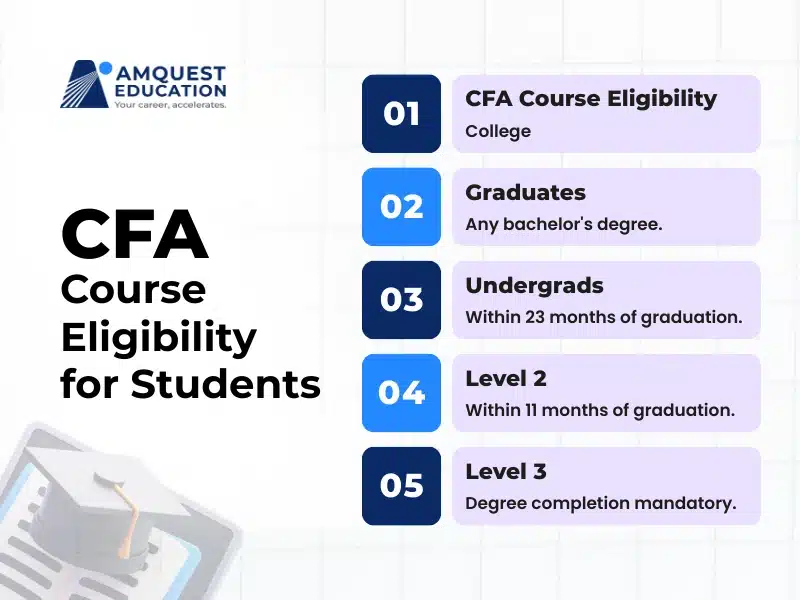
To get started with the Chartered Financial Analyst program, there are three main entry rules you have to follow. Basically, these criteria help make sure you’re prepared for the technical level of the exams before you commit.
Educational Qualifications Needed
- Graduates: You must hold a bachelor’s (or equivalent) degree from a recognized university.
- Undergraduates: You can register for the Level I exam if your graduation date is within 23 months of your chosen exam window.
- Equivalency: If you do not have a degree, you can still meet the CFA course eligibility through professional work experience.
English Language Requirement
The CFA Institute conducts all exams globally in English. You must be comfortable reading long, technical passages and choosing the correct answer from multiple-choice options or writing structured responses. No formal English test score like IELTS is required, but success depends on fluency.
Requirement of a Valid International Passport
The CFA Institute has a strict “International Passport Policy.” You cannot use a Driver’s License, PAN Card, or Aadhar Card to register. You must have a valid international travel passport. This ensures that identity is verified consistently across all testing locations worldwide.
Not Sure If You Qualify for CFA Level 1?
Speak to an expert and verify your eligibility before registering.
CFA Eligibility for Students
Students are one of the largest groups of candidates in India. The rules have recently become more flexible, allowing students to start earlier than ever before.
CFA Eligibility After Class 12
Directly after Class 12, you are not eligible to sit for the CFA exam. You must first enroll in an undergraduate program. The earliest you can register is during your second year of a three-year degree, provided your graduation is within 23 months.
CFA Eligibility for Undergraduate Students
- Level I: You can take the Level I exam when you have 23 months or fewer left before your graduation month.
- Level II: To sit for the Level II exam, you must be within 11 months of graduation.
- Level III: You must have completed your bachelor’s degree before you can register for the final level.
CFA Eligibility After Graduation
Once you have your degree, you meet the CFA course eligibility for Level I immediately. There are no restrictions on your field of study, whether you studied Arts, Science, or Commerce, your degree is valid for enrollment.
CFA Eligibility for Working Professionals
If you did not complete a university degree, you can still enter the program through the “Professional Work Experience” route.
Work Experience Requirements
- Hours: You must have 4,000 hours of professional work experience.
- Timeline: This experience must be gained over at least three sequential years (36 months).
- Type of Work: Work does not need to be finance-related. However, it must be “professional,” meaning it requires specialized knowledge or judgment. Paid internships count, but managing personal finances does not.
Rules for Full-Time vs Part-Time Work Experience
- Full-Time: Most full-time roles meet the 4,000-hour requirement within two to three years.
- Part-Time: Part-time work is also accepted, provided the total hours reach the 4,000-hour mark over a minimum of 36 months.
- No Overlap: If you were working while studying, you cannot count both at the same time toward the 4,000 hours. They must be accrued sequentially.
Age and Other Key Requirements for CFA Eligibility
Beyond education and work, there are administrative CFA exam requirements that you must follow.
Minimum Age Criteria
The CFA Institute does not set a specific minimum age. However, because you need to be in the second year of university or have years of work experience, most candidates are at least 18 to 20 years old when they start.
Passport and Required Documentation
Your passport must be valid on the day of your exam. If it expires before your test date, you can use it to register, but you must renew it and update your account details before the test day. If your name on the passport does not match your registration exactly, you will be turned away from the test center.
Are You Eligible for the 2026 CFA Exams?
Description: Speak with an Amquest Education counselor to confirm your eligibility.
CFA Eligibility Criteria for Each Level
Meeting the CFA course eligibility for the program is just the start. Each level has its own specific entry rules.
Eligibility for CFA Level 1
- Rule: 23 months from graduation OR 4,000 hours of work experience.
- Note: This is the entry point where you pay your enrollment fee. Starting in 2026, the $350 one-time enrollment fee has been eliminated to lower the entry barrier (Source: CFA Institute Pricing Updates).
Eligibility for CFA Level 2
- Rule: You must have passed the Level I exam AND be within 11 months of graduation (if a student).
- Work Path: If you used the work experience route for Level I, you are automatically eligible for Level II after passing Level I.
Eligibility for CFA Level 3
- Rule: You must have passed Level II AND have completed your bachelor’s degree (or equivalent).
- Degree Requirement: You cannot sit for Level III if you are still an undergraduate student.
CFA Course Duration and Fees at Amquest Education
The CFA Course duration usually spans 2 to 3 years. At Amquest Education, we offer a structured path to help you finish on time.
- Coaching Fees: Our CFA Level I prep starts at ₹30,000.
- In-Person Training: To help you move past just memorizing, we host face-to-face sessions in Mumbai where we break down the reasoning behind difficult financial equations.
- Placement Support: Our PGP in Digital Marketing and AI (₹4 Lakh) and Investment Banking courses come with dedicated placement help to ensure your CFA course leads to a high-paying job.
Join the CFA Elite
Transform your career with a globally respected finance credential.
Final Thoughts
The CFA charter remains the top choice for finance experts because of its higher standards. In an era of online certificates, the CFA stands out as a verified, rigorous proof of your ability to handle global investment standards. Whether you want to work in wealth management in Dubai or investment banking in New York, these three letters on your resume tell the world that you are among the most skilled and ethical professionals in the field.
To help you reach this goal, we focus on practical application rather than just theory. Our Mumbai center offers face-to-face training sessions. Additionally, we use actual market examples so you can grasp the reasoning behind difficult formulas instead of just memorizing them. This ensures that when you sit for the exam, you aren’t just guessing you are applying solid financial principles that stay with you for life.
Don’t leave your results to chance. Book a free counseling session at our Mumbai center and see how our classroom training can fast-track your finance career.
FAQs on CFA Course Eligibility
What is the minimum education required for CFA eligibility in India?
You need a bachelor’s degree in any field. If you are a student, you must be within 23 months of your graduation date to sit for the Level I exam.
Is work experience mandatory for CFA eligibility in India?
No, work experience is only mandatory if you do not have a bachelor’s degree. If you have a degree, you can enrol without any prior work experience.
Can final-year college students apply for the CFA Level I exam in India?
Yes. In fact, students can now apply even in their second year of a three-year degree, provided they are within 23 months of graduating.
How can I register for the CFA exams in India?
You must create an account on the CFA Institute website, verify your CFA exam eligibility, pay the registration fees, and then schedule your exam slot through Prometric.
What is the CFA exam fee in India?
For 2026, the enrollment fee is removed. Registration fees for each level range from $1,140 (early bird) to $1,490 (standard). In INR, this is roughly ₹95,000 to ₹1.25 Lakh plus 18% GST.
Which is better: CFA or MBA?
CFA is better for technical roles in research and portfolio management. An MBA is better for general management and networking. Many top professionals do both.
How many attempts are allowed for CFA exams?
You are allowed a maximum of six attempts per exam level.
What career options are available after completing CFA?
Common roles include Equity Research Analyst, Portfolio Manager, Risk Manager, and Investment Banker at top firms like JP Morgan, Goldman Sachs, and ICICI Bank.