India is rapidly becoming a global powerhouse for AI in education, and it is also backed by a ₹10,300 crore government investment through the IndiaAI Mission. And, the way we learn is currently going through its biggest shift since the invention of the printing press. In 2026, the whole new technology has moved past simple videos and quizzes. Today, the global market for AI in education is worth approximately $9.58 billion, and it is expected to grow by nearly 35% every year until 2035 (Source: Precedence Research). This isn’t just a trend for tech companies; it is a reality for millions of students.
From classrooms in Mumbai to universities in London, the application of AI in education is changing how teachers teach and how students grasp difficult concepts. This guide explores the meaning, the real-world uses, and why this shift matters for your career.
Comprehensive Summary
- AI in Schools: From automated attendance to smart whiteboards, classrooms are becoming more data-driven.
- Why It’s Important: It solves the “one size fits all” problem by giving every student a tutor who moves at their specific speed.
- Benefits: AI stops teacher burnout by taking over boring paperwork, allowing students to learn much faster than before.
- India’s Future: The government is investing ₹500 crore into a Centre of Excellence for AI to fix the country’s skill gap.
- Career Scope: This change is opening up thousands of new jobs for people who can design AI lessons or analyze student data.
Ready to Join India’s High-Growth AI Workforce?
With a ₹10,300 crore government push, the demand for AI experts is at an all-time high. Secure your spot in our next cohort and get “job-ready” for 2026.
What Is AI in Education?
Before we look at the tools, we need to understand the core concept. Many people ask, “what is AI in education?” Simply put, it is the use of computer systems that can perform tasks usually requiring a human brain, like understanding a student’s tone, spotting a mistake in a math problem, or suggesting a new way to explain a history lesson.
What Does Artificial Intelligence Mean in the Field of Education?
The AI full form in education stands for Artificial Intelligence. In this field, it means creating an environment where the software learns from the student. AI in the field of education acts like a 24/7 teaching assistant. It doesn’t replace the teacher; it handles the repetitive work so the teacher can focus on mentoring. It means having a system that knows you struggle with “geometry” but are great at “algebra” and adjusts your homework accordingly.
Why AI Is Important in Education Today
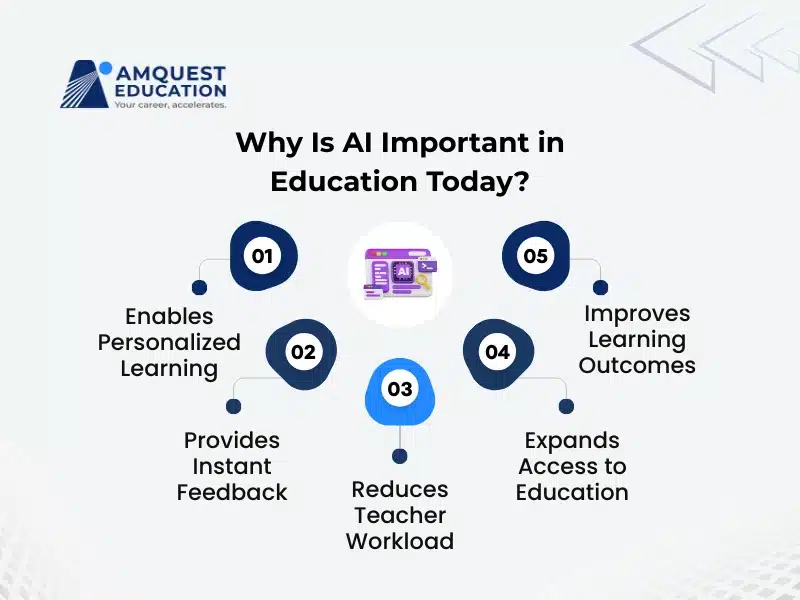
In a traditional classroom, one teacher often has to manage 40 to 60 students. It is physically impossible to give every child a custom lesson. This is where AI becomes a necessity.
How AI Is Transforming Traditional Learning Systems
Traditional systems are built on “rote memorization”—learning by repeating. AI is pushing us toward “conceptual understanding.” Instead of just reading a textbook, students use AI-driven simulations to see how physics or finance works in real life. By 2026, roughly 86% of students worldwide are already using some form of AI tool to help with their studies (Source: Mitr Learning).
Importance of AI in Education for Students and Teachers
For students, the technology offers a “safe space” to make mistakes without feeling judged. For teachers, it is a huge time-saver. Research shows that AI grading and admin tools can cut a teacher’s workload by 37% (Source: Technavio). This is why the importance of AI in education speech today focuses on “human-led, AI-supported” classrooms.
How AI Is Used in Education
The uses of artificial intelligence in education are becoming invisible because they are built into the apps we use every day.
Applications of AI in Education
The application of AI in education can be broken down into a few key areas that are changing the daily school routine.
Personalized Learning Systems
This is perhaps the biggest win for artificial intelligence in education. These systems track a student’s progress and create a unique “map” for their learning. No two students have the same homework because the AI knows exactly what each one needs to practice.
Intelligent Tutoring Systems
Think of these as “chatbots that teach.” Unlike a simple search engine, an intelligent tutor asks the student questions and guides them to the answer, just like a real teacher would during a 1-on-1 session.
Instant Feedback
AI grades work immediately. Students learn faster, and teachers save roughly 12 hours of manual work every week.
Bite-Sized Content
Heavy textbooks are turned into 1-minute videos and quick flashcards. It makes studying faster and much easier for students to handle.
2.0 Help Desk
Students get 24/7 support. Chatbots answer questions about homework or deadlines late at night, so learning never stops when school ends.
Simple Logistics
AI manages bus routes and meeting schedules. This clears the paperwork so school leaders can focus on teaching.
Want to Boost Your Salary by 40% with AI Skills?
The biggest benefit of AI is the career edge it gives you. Our students are landing high-paying roles by combining domain expertise with advanced AI automation.
AI in Schools and Higher Education
The way AI is used in education depends on the age of the student.
AI in Schools
AI in schools uses interactive tools and games to keep students focused on their work. Beyond the fun, it helps schools find students who need extra help long before their grades start to drop or they fail a big test.
AI in Colleges and Universities
At the university level, AI is used for deep research and career planning. Colleges use AI to match students with the right internships and to help professors analyze massive amounts of research data in seconds.
Real-World AI in Education Examples
Seeing AI in education examples helps us understand that this technology is already here.
AI in Education Examples Across the World
- Duolingo: Uses AI to learn which words you forget and tests you on them more often.
- Coursera: Uses AI to suggest which course you should take next based on your career goals.
- Khan Academy (Khanmigo): An AI tutor that helps students solve problems without giving them the answer.
Examples of Artificial Intelligence in Indian Education
In India, platforms like DIKSHA are using AI to offer personalized content to millions of students in regional languages. Startups like Amquest Education are also leading the way by integrating AI tools into their finance and marketing courses, ensuring students are ready for a tech-driven workforce.
Benefits of Artificial Intelligence in Education
The benefits of artificial intelligence in education are felt by everyone in the system.
Benefits for Students
AI gives students a private space to learn without the fear of making mistakes. You can ask the same basic question a dozen times until you truly understand it, with no risk of feeling embarrassed. It also helps students with disabilities by providing essential tools like live captions and voice-to-text.
Benefits for Teachers
Teachers can stop drowning in paperwork and start focusing on their students. Instead of guessing who is falling behind, they get clear numbers showing exactly where the class is stuck. If the data shows that most students didn’t get the last lesson, the teacher can stop and fix that confusion right away.
Benefits for Educational Institutions
Institutions can run more efficiently and keep costs down. By using AI to manage enrollments and facility energy use, schools can put more money back into student scholarships and better equipment.
Challenges and Limitations of AI in Education
Every new tool has its hurdles. We must be smart about how we roll out AI in the field of education.
Data Privacy and Security Concerns
Because AI needs student data to work, we must ensure that this data is locked tight. Schools must follow strict laws to make sure a child’s learning history is never sold or leaked.
Bias in AI Algorithms
A computer doesn’t know right from wrong; it just follows patterns. If those patterns are biased, the AI will be too. To protect students, we need experts to supervise the technology and ensure that no one is being left behind because of a glitch in the data.
High Implementation Costs
Smart tech saves money over time, yet the initial price tag is high. There is a real risk that smaller schools will be left out, making it harder for their students to keep up with those who have access to the latest tools.
Teacher Training and Adaptability Issues
A tool is only as good as the person using it. We must invest in training teachers so they feel like “pilots” of this technology rather than being intimidated by it.
Role of AI in the Future of Education
What does the classroom of 2030 look like? It is a place where the physical and digital worlds blend perfectly.
How AI Will Shape Future Learning Models
We will move away from “Degrees” and toward “Skills.” AI will track what you know, not just what classes you sat through. This “Competency-Based” model means you graduate as soon as you master the skill.
Future Classrooms Powered by Artificial Intelligence
Imagine a history class where AI creates a VR (Virtual Reality) experience of ancient Rome, or a science class where you can “shrink” down to see how an atom works. This is the future of AI in education.
AI and Lifelong Learning
Learning doesn’t end the day you graduate. Think of modern tools as a career coach that stays with you, spotting shifts in your industry and showing you exactly which skills to pick up to keep your resume fresh and relevant.
Future Scope of AI in Education in India
The future of artificial intelligence in India is massive because of our scale.
Growth of AI-Driven EdTech in India
India’s massive student population makes it the best place to build and perfect educational tech. Developers here focus on making apps that work on affordable smartphones and slow internet, ensuring that a lack of expensive gear doesn’t stop a child from getting a quality education.
Scope of AI in Future – India Perspective
Feature | 2026 Status | 2030 Projection |
Market Value | ~$6 Billion | $20 Billion+ |
User Base | 100 Million Students | 250 Million Students |
Primary Focus | Exam Prep | Skill-Based Learning |
Government and Institutional Adoption
The NEP (National Education Policy) is already pushing for coding and AI to be taught from Class 6. This ensures the next generation doesn’t just “use” AI but knows how to “build” it.
Career Opportunities Related to AI in Education
We are seeing a rise in new job titles:
- Learning Experience Designers: People who create the AI “flow” for a course.
- Educational Data Analysts: People who read student data to improve schools.
Ethics Consultants: People who test software to make sure it is fair, and age-appropriate for children.
Ready to Lead the AI Revolution?
Don’t just watch the future happen—build it. Master Agentic AI and advanced automation with Amquest Education and future-proof your career today.
How Is AI Globally Changing the Education System
Digital tools have finally leveled the playing field in education. Geography no longer limits a student’s potential; a child in a remote village now has access to the exact same high-quality lessons as someone in a major city.
Inclusive and Accessible Education
AI is the ultimate equalizer. It provides “Sign-to-Speech” for deaf students and “Text-to-Braille” for blind students. It removes the barriers that kept people out of the classroom for centuries.
Conclusion
AI is a huge step forward for how we learn, but it works best when it supports human teaching. It helps teachers spend less time on paperwork and more time helping students. Bringing this into our schools now ensures that every child has a personal support system, helping them learn faster and with more confidence.
FAQs on the AI in Education
What is AI in education?
It is the use of smart software to personalize learning, automate grading, and help students and teachers work more efficiently through data-driven insights.
How is AI used in education?
AI is used to create personalized homework, provide 24/7 tutoring via chatbots, and help teachers grade papers and manage their classrooms faster.
What is the main advantage of AI in education?
The real win is that it works like a private tutor for every student. It notices exactly where you’re struggling and changes the lesson in real-time so you can master a topic before moving on.
What are some examples of AI in education?
Common AI in education examples include language apps like Duolingo, smart tutors like Khan Academy’s Khanmigo, and automated grading systems used in universities.
What is the future of AI in education?
The future involves “Invisible AI” built into every learning tool, immersive VR classrooms, and a focus on mastering skills rather than just passing tests.
Which AI is best for education?
The “best” AI depends on the goal, but platforms like Khanmigo for tutoring, Gradescope for grading, and Duolingo for languages are currently world leaders.